


Global Servo Systems Market Growth 2026-2032
Jan 2026
Machinery And Equipment
Pages: 156
ILR1170
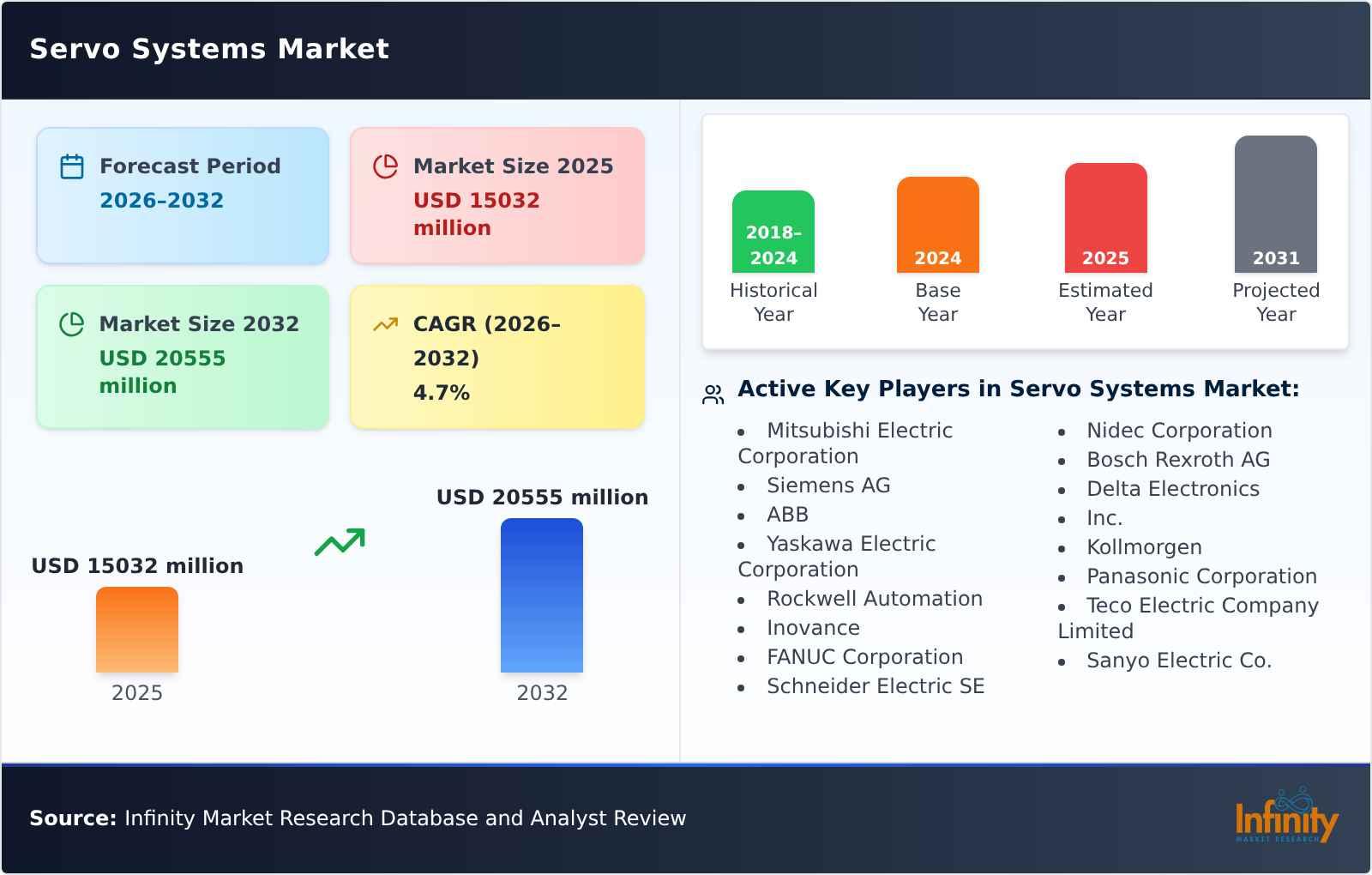
The global Servo Systems market size is predicted to grow from US$ 15032 million in 2025 to US$ 20555 million in 2032; it is expected to grow at a CAGR of 4.7% from 2026 to 2032.
Explore this report in detail? Download a free sample copy
Download Free Sample Report
A servo system is a precision motion-control solution based on closed-loop feedback, designed to achieve high-accuracy and fast-response control of an actuators position, speed, and torque. Under the definition used in this report, a servo system consists of two components: a servo drive and a servo motor. The servo drive receives commands from the upper-level controller (e.g., pulse, analog, or fieldbus commands), performs multi-loop control calculations across current, speed, and position, and converts the commands into electrical power output to the motor. The servo motor converts electrical energy into mechanical output torque and speed, andtogether with feedback signals from an encoder or resolverenables closed-loop regulation. Working in tandem, the two components allow the system to maintain low error and high repeatability even under load disturbances, inertia variations, or high-speed acceleration/deceleration conditions.
In application, servo systems serve as the core power and control unit enabling automation equipment to deliver both high precision and high throughput. They are widely deployed in multi-axis motion scenarios such as joint axes of industrial robots, feed axes and spindle drives of CNC machine tools, semiconductor and 3C assembly equipment, as well as packaging, printing, and logistics sorting systems. In high-end equipment and specialized industries, servo systems are also commonly used in precision positioning stages, test and measurement equipment, aerospace ground support equipment, and medical devices where motion trajectory fidelity and stability requirements are more stringent. With ongoing advances in industrial fieldbuses and highly integrated motor technologies, servo systems are evolving toward multi-axis synchronization, networked diagnostics, drivemotor integration, and higher power density. By increasing bandwidth, reducing latency, and strengthening adaptive control capability, they continue to support the upgrading of precision and productivity in advanced manufacturing. In 2025, global servo system production reached 29.55 million units, with an average selling price of USD 520 per unit.
A servo system is a precision motion-control core built on closed-loop feedback. Under the definition used in this report, it consists of two components: a servo drive and a servo motor. The servo drive receives upper-level control commands and performs multi-loop control and power conversion (current, speed, and position loops), while the servo motor delivers stable torque and speed and relies on feedback from an encoder or resolver to enable real-time closed-loop correction. Working in tandem, the two components allow the system to maintain low error and high repeatability even under load disturbances, inertia variations, and high-speed acceleration/deceleration conditions, making servo systems a key power and control unit for automation equipment to achieve both high precision and high throughput.
From an application perspective, servo systems are widely deployed in multi-axis motion scenarios such as joint axes of industrial robots, feed axes of CNC machine tools (and in some cases spindle drives), as well as semiconductor and 3C assembly equipment, packaging and printing machines, and logistics sorting systems. In lithium-ion battery, photovoltaic, and LED manufacturing equipment, rising process requirementssuch as tension control, synchronized following, and high-speed positioningare further driving servo systems toward higher bandwidth, lower latency, and stronger vibration suppression. With the broader adoption of industrial fieldbuses and growing demand for multi-axis synchronization, integrated servos, networked diagnostics, and drivemotor integrated solutions are gaining penetration. Competition is therefore expanding from hardware performance alone to commissioning efficiency, system compatibility, and delivery/service capability.
Regionally and structurally, demand and manufacturing capacity are concentrated in East Asia, Europe, and North America. China, in particular, continues to generate incremental demand driven by general automation and the expansion of new-energy equipment. Japan and Europe retain strong positions in mid-to-high-end segments such as machine tools, robotics, and high-reliability process equipment, while North America tends to emphasize high-end discrete automation and system-level solutions. In terms of product structure, AC servos remain the mainstream, spanning low-voltage micro servo (48V), general-purpose 200V, and medium-to-high-power 400V classes. In high-end machine tools, linear-motor platforms, precision positioning, and force-controlled press-fit applications, servo systems continue to evolve toward higher-resolution feedback, higher power density, and stronger real-time performance.
On cost and profitability, servo-motor costs are primarily driven by permanent magnets, copper, electrical steel laminations, bearings, and feedback devices (encoders/resolvers). Servo-drive costs are centered on power semiconductors (IGBT/SiC), capacitors and inductors, PCBs, and thermal-management structures, alongside expenditures on testing and calibration, software/algorithms, and reliability validation that create differentiation. Overall, gross margin for the industry is in the range of 35%45%, with general-purpose products relying more on scale and supply-chain efficiency, while high-performance and application-specific products depend more on control algorithms, reliability design, and system-level delivery capability.
On the manufacturing side, single-line capacity varies significantly with power class, automation level, and test-cycle time. For general-purpose servo systems (servo drive + servo motor sold as a set), a large-scale automated line typically supports an annual single-line capacity of 100300 thousand sets; for mature lines with more standardized processes and higher test parallelization, single-line capacity can reach 300500 thousand sets per year. It should be noted that the annual shipments of several hundred thousand sets disclosed for many companies typically reflect the combined output of multiple lines and/or multiple sites, and therefore should not be directly equated with single-line capacity. For this reason, the report presents single-line capacity as a range to accommodate differences in manufacturing organization across vendors.
In the value chain, upstream includes magnetic materials, power semiconductors, electronic components, and feedback-device suppliers; midstream comprises servo motor/drive manufacturing and control algorithm platforms; downstream includes robot, machine tool, and other automation equipment OEMs as well as system integrators. The competitive landscape is tiered: international leaders maintain advantages in high-end and complex process scenarios, while Chinese vendors are scaling in the mid-range and accelerating upgrades toward higher-end markets. Looking ahead, servo systems will continue evolving toward higher power density (including wider SiC adoption), higher bandwidth and vibration suppression, stronger networked diagnostics and predictive maintenance, and greater drivemotor integration, modularization, and platformizationfurther enabling upgrades in precision and productivity across advanced manufacturing.
Infinity Market Research newest research report, the Servo Systems Industry Forecast looks at past sales and reviews total world Servo Systems sales in 2025, providing a comprehensive analysis by region and market sector of projected Servo Systems sales for 2026 through 2032. With Servo Systems sales broken down by region, market sector and sub-sector, this report provides a detailed analysis in US$ millions of the world Servo Systems industry.
This Insight Report provides a comprehensive analysis of the global Servo Systems landscape and highlights key trends related to product segmentation, company formation, revenue, and market share, latest development, and M&A activity. This report also analyzes the strategies of leading global companies with a focus on Servo Systems portfolios and capabilities, market entry strategies, market positions, and geographic footprints, to better understand these firms unique position in an accelerating global Servo Systems market.
This Insight Report evaluates the key market trends, drivers, and affecting factors shaping the global outlook for Servo Systems and breaks down the forecast by Type, by Application, geography, and market size to highlight emerging pockets of opportunity. With a transparent methodology based on hundreds of bottom-up qualitative and quantitative market inputs, this study forecast offers a highly nuanced view of the current state and future trajectory in the global Servo Systems.
This report presents a comprehensive overview, market shares, and growth opportunities of Servo Systems market by product type, application, key manufacturers and key regions and countries.
Segmentation by Type:
DC Servo Systems
AC Servo Systems
Segmentation by Power:
Less than 2KW
2-5KW
More than 5KW
Segmentation by Degree of Specialization:
General-purpose Servo Systems
Specialized Servo Systems
Segmentation by Application:
3C
Machine Tools
Semiconductor Manufacturing Equipment
LED Equipment
Solar Power Generation Equipment
Lithium Ion Battery Manufacturing Equipment
Robots
General Manufacturing Machinery
Others
This report also splits the market by region:
Americas
United States
Canada
Mexico
Brazil
APAC
China
Japan
Korea
Southeast Asia
India
Australia
Europe
Germany
France
UK
Italy
Russia
Middle East & Africa
Egypt
South Africa
Israel
Turkey
GCC Countries
The below companies that are profiled have been selected based on inputs gathered from primary experts and analysing the companys coverage, product portfolio, its market penetration.
Mitsubishi Electric Corporation
Siemens AG
ABB
Yaskawa Electric Corporation
Rockwell Automation
Inovance
FANUC Corporation
Schneider Electric SE
Nidec Corporation
Bosch Rexroth AG
Delta Electronics, Inc.
Kollmorgen
Panasonic Corporation
Teco Electric Company Limited
Sanyo Electric Co., Ltd.
Midea Group
Moog
Parker Hannifin Corporation
Fuji Electric Co., Ltd.
Omron
Oriental Motor
Key Questions Addressed in this Report
What is the 10-year outlook for the global Servo Systems market?
What factors are driving Servo Systems market growth, globally and by region?
Which technologies are poised for the fastest growth by market and region?
How do Servo Systems market opportunities vary by end market size?
How does Servo Systems break out by Type, by Application?
Servo Systems Market Scope
| Report Attribute | Details |
|---|---|
| Market Size (Start Year) | USD XX Million |
| Market Size (End Year) | USD XX Million |
| Compound Annual Growth Rate (CAGR) | USD XX Million |
| Forecast Period | USD XX Million |
| Base Year | USD XX Million |
| Historical Data | USD XX Million |
| Key Players | USD XX Million |
REPORT COVERAGE
Revenue forecast, Company Analysis, Industry landscape, Growth factors, and Trends
SEGMENT COVERED
By component, deployment, organization size, application, and industry.
REGIONAL SCOPE
North America, Europe, Asia Pacific, Middle East & Africa, South & Central America
COUNTRY SCOPE
Includes key countries across all major regions.
Frequently Asked Questions
1. What is the market size of Global Servo Systems Market?
Answer: The global Servo Systems market size is predicted to grow from US$ 15032 million in 2025 to US$ 20555 million in 2032; it is expected to grow at a CAGR of 4.7% from 2026 to 2032.
2. Which regions are analyzed in the Global Servo Systems Market report?
Answer: The Global Servo Systems Market report covers major regions such as North America, Europe, Middle East & Africa. Each region is analyzed for trends, opportunities, and market dynamics.
3. What methodology is used for forecasting of Global Servo Systems Market?
Answer: The Global Servo Systems Market report uses a mix of primary research, secondary data, and expert analysis.
4. Are emerging markets analyzed separately in the Global Servo Systems Market?
Answer: Yes, the Global Servo Systems Market report highlights high-growth emerging regions with dedicated insights.
5. Does the report include competitive benchmarking of Global Servo Systems Market?
Answer: Yes, Global Servo Systems Market report compares major players based on revenue, product portfolio, and innovation.
6. Can I access country-level data within the Global Servo Systems Market report?
Answer: Yes, Global Servo Systems Market report includes detailed data by country for major regions.
7. Can I get customized insights or data from the Global Servo Systems Market report?
Answer: Yes, we offer customization options to align with your specific business needs. You can request tailored sections or regional breakdowns.