


Global Single Photon LiDAR Market Growth (Status and Outlook) 2026-2032
Jan 2026
Semiconductor and Electronics
Pages: 85
ILR1164
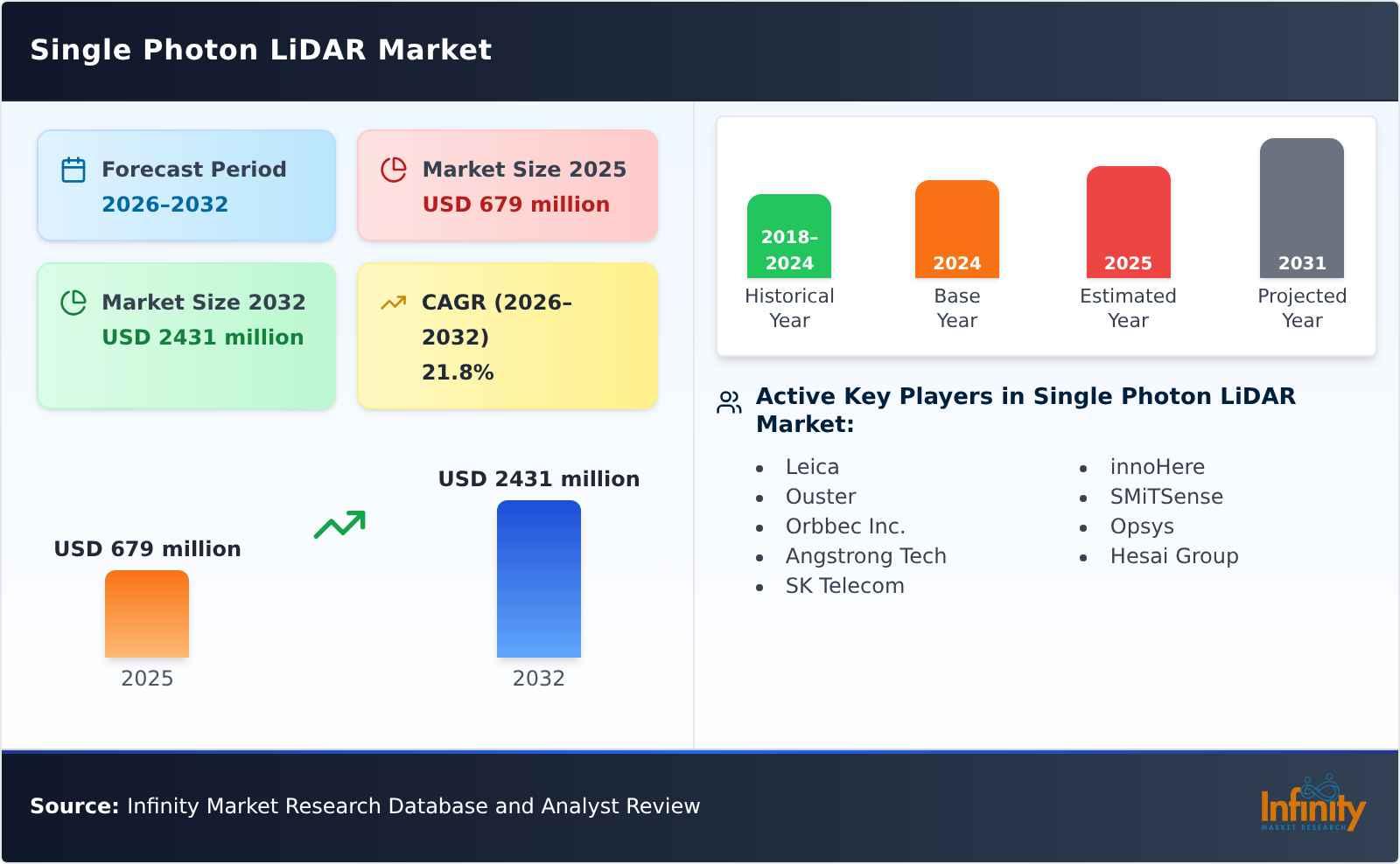
The global Single Photon LiDAR market size is predicted to grow from US$ 679 million in 2025 to US$ 2431 million in 2032; it is expected to grow at a CAGR of 21.8% from 2026 to 2032.
Explore this report in detail? Download a free sample copy
Download Free Sample Report
Single-photon LiDAR (also known as photon counting LiDAR) has a detection sensitivity of the order of single photons. Compared with traditional linear detection LiDAR, it can achieve a longer detection distance and has become the forefront and development trend of LiDAR detection technology. Single-photon LiDAR is an advanced laser detection and ranging (LiDAR) system. Its core is to use single-photon detection technology (Single-Photon Avalanche Diode, SPAD) to achieve high-sensitivity and high-precision three-dimensional imaging. This technology emits extremely weak laser pulses (usually at the single-photon level) and detects single photons reflected back by the target, combined with high-precision time-correlated single photon counting (TCSPC) technology to achieve accurate measurement of target distance, speed, shape and other information. Single-photon LiDAR has the advantages of long detection distance, high resolution and strong anti-interference ability.
The industrys gross profit margin can reach 15%-35%.Upstream: Covering core components such as lasers, detectors, FPGA chips, and optical elements, domestic substitution is accelerating, with VCSEL lasers and SPAD detectors becoming key areas for technological breakthroughs.Single-photon lidar is an emerging technology product. Currently, its price mainly depends on downstream customized needs, and a standardized product pricing model has not yet been established.Prices range from several thousand to tens of thousands of US dollars.
Analysis of market drivers of single-photon LiDAR
1. Technological progress and innovation
Breakthrough in single-photon detection technology: With the maturity of SPAD array technology, the detection sensitivity and resolution of single-photon LiDAR have been significantly improved, and high-precision imaging can be achieved at longer distances and in more complex environments.
Integration and miniaturization: Advances in semiconductor processes have greatly reduced the size and weight of single-photon LiDAR, making it easier to integrate into various mobile platforms (such as drones and self-driving cars).
Cost reduction: Large-scale production and process optimization have reduced the manufacturing cost of single-photon LiDAR, promoting its popularization from high-end military applications to the civilian market.
2. Growing demand for autonomous driving and intelligent transportation
Advanced driver assistance systems (ADAS): Autonomous vehicles require high-precision environmental perception capabilities, and single-photon LiDAR can provide centimeter-level three-dimensional maps to support vehicles to achieve autonomous navigation and obstacle avoidance.
Vehicle-to-road collaboration (V2X): In intelligent transportation systems, single-photon LiDAR can be deployed in road infrastructure (such as traffic lights and roadside units) to achieve efficient collaboration between vehicles and roads.
Policy promotion: Many governments have introduced policies for autonomous driving testing and commercialization to accelerate the application of single-photon lidar in the field of intelligent transportation.
3. Demand for topographic mapping and urban modeling
High-precision map production: Single-photon lidar can quickly obtain large-area terrain data, generate high-precision digital elevation models (DEMs) and three-dimensional urban models, and support smart city planning and management.
Disaster monitoring and emergency response: After disasters such as earthquakes and floods, single-photon lidar can quickly assess terrain changes and provide data support for rescue decisions.
Infrastructure construction: In bridges, tunnels, highways and other projects, single-photon lidar is used for deformation monitoring and quality inspection to improve construction safety.
4. Environmental monitoring and resource management
Forest cover monitoring: Through lidar point cloud data, forest canopy density, tree height and biomass can be accurately calculated to support carbon neutrality goals and ecological protection.
Water resource management: Single-photon lidar can measure changes in river terrain and water depth, providing a basis for flood control and drought relief and water resource scheduling.
Precision agricultural management: Deploy single-photon LiDAR in farmland to monitor crop growth and soil moisture, and achieve variable fertilization and irrigation.
5. Security monitoring and military applications
Border and key point protection: Single-photon LiDAR can achieve all-weather, long-distance target detection and tracking, and improve the response speed of the security system.
Military reconnaissance and target strike: In the military field, single-photon LiDAR is used in scenarios such as drone reconnaissance and missile guidance to improve combat effectiveness.
Anti-UAV system: Combined with AI algorithms, single-photon LiDAR can quickly identify and track low-altitude, slow-moving small targets (such as drones) and support countermeasures.
6. Policy support and capital investment
Government R&D funding: Many countries have listed LiDAR technology as a strategic emerging industry, and support the development of enterprises through scientific research project funding and tax incentives.
Venture capital and IPO: Single-photon LiDAR start-ups have received a lot of venture capital, and some companies have been listed through IPOs to promote the commercialization of technology.
Industry standard formulation: The International Organization for Standardization (ISO) and national institutions are formulating LiDAR performance and testing standards to regulate market development.
The growth of the single-photon LiDAR market is driven by multiple factors, including technological progress, demand for autonomous driving, demand for terrain mapping, demand for environmental monitoring, demand for security monitoring, and policy support. As technology matures and costs fall, single-photon LiDAR will be popularized from high-end military applications to the civilian market, and will play a key role in autonomous driving, smart cities, ecological protection and other fields.
Infinity Market Research newest research report, the Single Photon LiDAR Industry Forecast looks at past sales and reviews total world Single Photon LiDAR sales in 2025, providing a comprehensive analysis by region and market sector of projected Single Photon LiDAR sales for 2026 through 2032. With Single Photon LiDAR sales broken down by region, market sector and sub-sector, this report provides a detailed analysis in US$ millions of the world Single Photon LiDAR industry.
This Insight Report provides a comprehensive analysis of the global Single Photon LiDAR landscape and highlights key trends related to product segmentation, company formation, revenue, and market share, latest development, and M&A activity. This report also analyses the strategies of leading global companies with a focus on Single Photon LiDAR portfolios and capabilities, market entry strategies, market positions, and geographic footprints, to better understand these firms unique position in an accelerating global Single Photon LiDAR market.
This Insight Report evaluates the key market trends, drivers, and affecting factors shaping the global outlook for Single Photon LiDAR and breaks down the forecast by Type, by Application, geography, and market size to highlight emerging pockets of opportunity. With a transparent methodology based on hundreds of bottom-up qualitative and quantitative market inputs, this study forecast offers a highly nuanced view of the current state and future trajectory in the global Single Photon LiDAR.
This report presents a comprehensive overview, market shares, and growth opportunities of Single Photon LiDAR market by product type, application, key players and key regions and countries.
Segmentation by Type:
Solid State LiDAR
Mechanical LiDAR
Segmentation by Technology:
ToF
FMCW
Segmentation by Functional Category:
Surveying Grade
Navigation Grade
Automotive Grade
Industrial Grade
Segmentation by Application:
Consumer Products
Automobiles
Mapping
Other
This report also splits the market by region:
Americas
United States
Canada
Mexico
Brazil
APAC
China
Japan
Korea
Southeast Asia
India
Australia
Europe
Germany
France
UK
Italy
Russia
Middle East & Africa
Egypt
South Africa
Israel
Turkey
GCC Countries
The below companies that are profiled have been selected based on inputs gathered from primary experts and analyzing the companys coverage, product portfolio, its market penetration.
Leica
Ouster
Orbbec Inc.
Angstrong Tech
SK Telecom
innoHere
SMiTSense
Opsys
Hesai Group
Single Photon LiDAR Market Scope
| Report Attribute | Details |
|---|---|
| Market Size (Start Year) | USD XX Million |
| Market Size (End Year) | USD XX Million |
| Compound Annual Growth Rate (CAGR) | USD XX Million |
| Forecast Period | USD XX Million |
| Base Year | USD XX Million |
| Historical Data | USD XX Million |
| Key Players | USD XX Million |
REPORT COVERAGE
Revenue forecast, Company Analysis, Industry landscape, Growth factors, and Trends
SEGMENT COVERED
By component, deployment, organization size, application, and industry.
REGIONAL SCOPE
North America, Europe, Asia Pacific, Middle East & Africa, South & Central America
COUNTRY SCOPE
Includes key countries across all major regions.
📘 Frequently Asked Questions
1. What is the market size of Global Single Photon LiDAR Market?
Answer: The global Single Photon LiDAR market size is predicted to grow from US$ 679 million in 2025 to US$ 2431 million in 2032; it is expected to grow at a CAGR of 21.8% from 2026 to 2032.
2. Which regions are analyzed in the Global Single Photon LiDAR Market report?
Answer: The Global Single Photon LiDAR Market report covers major regions such as Europe, Middle East & Africa. Each region is analyzed for trends, opportunities, and market dynamics.
3. What methodology is used for forecasting of Global Single Photon LiDAR Market?
Answer: The Global Single Photon LiDAR Market report uses a mix of primary research, secondary data, and expert analysis.
4. Are emerging markets analyzed separately in the Global Single Photon LiDAR Market?
Answer: Yes, the Global Single Photon LiDAR Market report highlights high-growth emerging regions with dedicated insights.
5. Does the report include competitive benchmarking of Global Single Photon LiDAR Market?
Answer: Yes, Global Single Photon LiDAR Market report compares major players based on revenue, product portfolio, and innovation.
6. Can I access country-level data within the Global Single Photon LiDAR Market report?
Answer: Yes, Global Single Photon LiDAR Market report includes detailed data by country for major regions.
7. Can I get customized insights or data from the Global Single Photon LiDAR Market report?
Answer: Yes, we offer customization options to align with your specific business needs. You can request tailored sections or regional breakdowns.