


Global Smart Toilet System Market Growth (Status and Outlook) 2026-2032
Jan 2026
Information and Communication Technology
Pages: 102
ILR1612
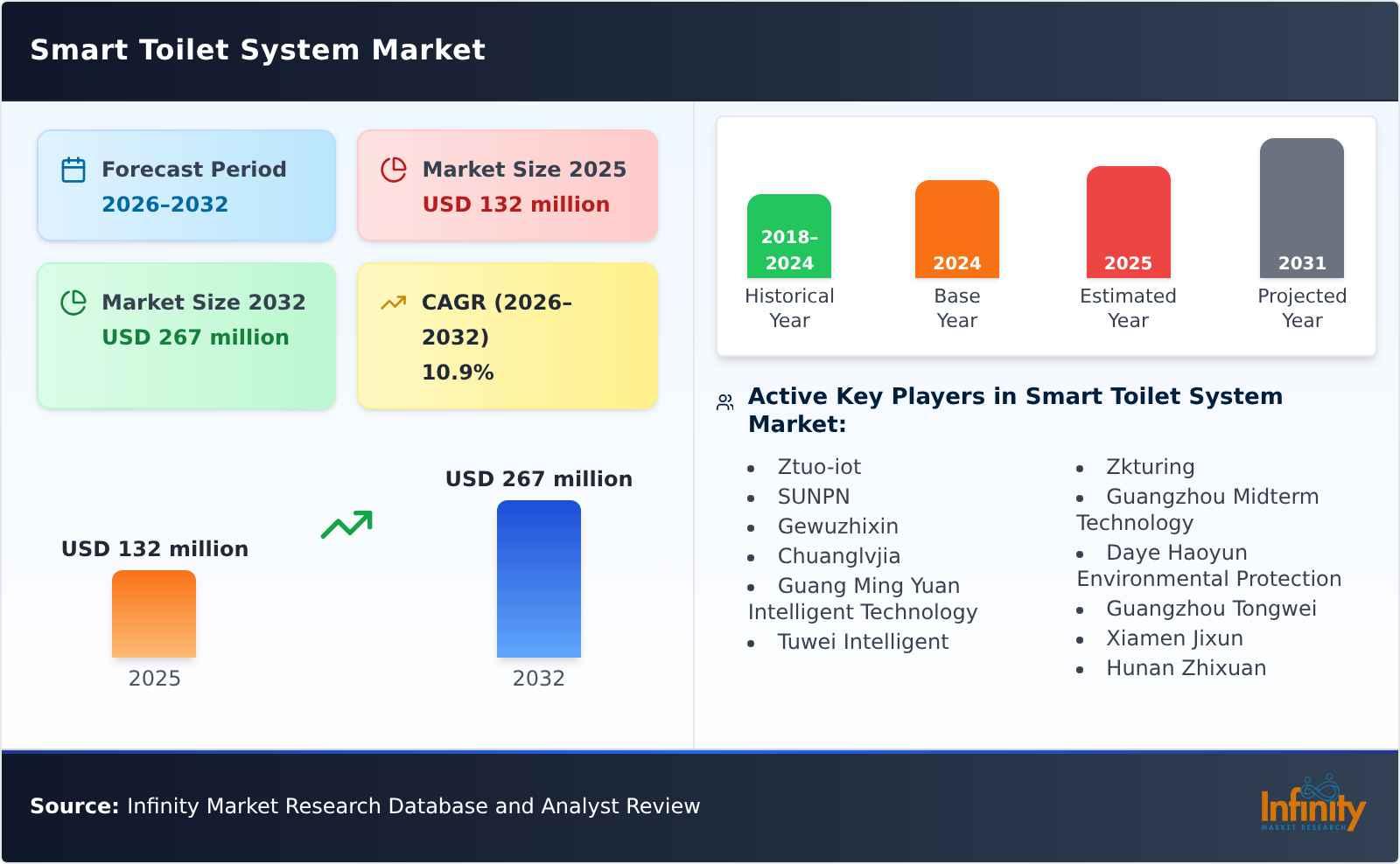
The global Smart Toilet System market size is predicted to grow from US$ 132 million in 2025 to US$ 267 million in 2032; it is expected to grow at a CAGR of 10.9% from 2026 to 2032.
Explore this report in detail? Download a free sample copy
Download Free Sample Report
A smart toilet system is an intelligent management system that integrates functions such as toilet occupancy detection, air quality and odor monitoring, automatic flushing and water-saving control, lighting and ventilation linkage, passenger flow statistics, consumable inventory monitoring, fault alarms, and cleaning scheduling in public restrooms. This is achieved through IoT sensors, gateways, display terminals, and a cloud platform. It can sense in real time whether each toilet stall is occupied, whether air quality exceeds standards, and whether equipment is malfunctioning. It automatically triggers flushing, ventilation, deodorization, water and paper replenishment, or sends cleaning work orders. Simultaneously, it uploads operational data to a management platform or city/park central control system, enabling remote monitoring, usage analysis, and operation and maintenance optimization. This improves the hygiene level, user experience, and water and electricity consumption management efficiency of public toilets without requiring a significant increase in manpower.
From the perspective of demand and policy drivers, smart toilet systems have shifted from being a nice-to-have to a visible indicator for urban governance and service evaluation. On the one hand, policies such as the toilet revolution, cultural tourism service quality rating, civilized city creation, and refined city/refined management have incorporated the quantity, cleanliness, accessibility, and intelligence level of public toilets into assessments. Urban managers no longer only look at whether there are enough or whether they are sufficient, but rather at how well they are used, whether there are complaints, and whether data speaks for itself. Scenic spots, highway service areas, transportation hubs, large parks, and commercial districts are increasingly demanding real-time guidance, odor reduction, queue optimization, and barrier-free user experiences. On the other hand, rising labor costs and a shortage of cleaning staff are making the traditional point-to-point toilet inspection method increasingly difficult to match the significant fluctuations in visitor flow between peak and off-peak hours, forcing operators to seek digital tools for on-demand cleaning and data-driven decision-making. As long as the system can produce quantifiable results in reducing complaints, saving water and electricity, and increasing efficiency with reduced manpower, budget approvals and the willingness of governments or property owners to pay for it will usually increase significantly.
From a supply and business model perspective, smart toilet systems are undergoing an upgrade from piling up hardware and selling a complete project to platformization + operation and maintenance services + data monetization. At the hardware level (toilet stall sensors, air/odor sensors, door locks, lighting controls, displays, gateways), prices are highly standardized and transparent. Simply competing on equipment easily leads to price wars. The real differentiation lies in: system integration capabilities (whether it can connect to city brains or park IoT platforms), algorithms and dashboards (how to turn toilet stall utilization, odor warnings, cleaning performance, and energy consumption into management decision-making indicators), and ongoing services surrounding cleaning outsourcing, consumable supply, and water and electricity optimization. Some manufacturers have already tried a light CAPEX + heavy OPEX modelinitially deploying the system through packaged upgrades or phased investments, and subsequently charging platform service fees and maintenance fees based on the number of public toilets, the number of toilets, or service levels, while also adding value-added services such as advertising, surrounding signage, and mini-program traffic. In the medium to long term, whoever can integrate smart toilet systems into a larger digital operation of park/scenic area/urban space has the opportunity to upgrade from a single project contractor to an integral part of regional public space operation, achieving cross-project replication and greater long-term cash flow stability.
Infinity Market Research newest research report, the Smart Toilet System Industry Forecast looks at past sales and reviews total world Smart Toilet System sales in 2025, providing a comprehensive analysis by region and market sector of projected Smart Toilet System sales for 2026 through 2032. With Smart Toilet System sales broken down by region, market sector and sub-sector, this report provides a detailed analysis in US$ millions of the world Smart Toilet System industry.
This Insight Report provides a comprehensive analysis of the global Smart Toilet System landscape and highlights key trends related to product segmentation, company formation, revenue, and market share, latest development, and M&A activity. This report also analyses the strategies of leading global companies with a focus on Smart Toilet System portfolios and capabilities, market entry strategies, market positions, and geographic footprints, to better understand these firms unique position in an accelerating global Smart Toilet System market.
This Insight Report evaluates the key market trends, drivers, and affecting factors shaping the global outlook for Smart Toilet System and breaks down the forecast by Type, by Application, geography, and market size to highlight emerging pockets of opportunity. With a transparent methodology based on hundreds of bottom-up qualitative and quantitative market inputs, this study forecast offers a highly nuanced view of the current state and future trajectory in the global Smart Toilet System.
This report presents a comprehensive overview, market shares, and growth opportunities of Smart Toilet System market by product type, application, key players and key regions and countries.
Segmentation by Type:
Software
Complete System
Segmentation by Display Terminal Type:
Indoor Display System
Outdoor Display System
Integrated Multi-function Display Terminal
Segmentation by Installation Method:
Wall-mounted Display System
Pedestal/Floor-standing Display System
Embedded Display System
Segmentation by Application:
Scenic Spot
Service Area
Municipal
Office Building
Others
This report also splits the market by region:
Americas
United States
Canada
Mexico
Brazil
APAC
China
Japan
Korea
Southeast Asia
India
Australia
Europe
Germany
France
UK
Italy
Russia
Middle East & Africa
Egypt
South Africa
Israel
Turkey
GCC Countries
The below companies that are profiled have been selected based on inputs gathered from primary experts and analyzing the companys coverage, product portfolio, its market penetration.
Ztuo-iot
SUNPN
Gewuzhixin
Chuanglvjia
Guang Ming Yuan Intelligent Technology
Tuwei Intelligent
Zkturing
Guangzhou Midterm Technology
Daye Haoyun Environmental Protection
Guangzhou Tongwei
Xiamen Jixun
Hunan Zhixuan
Smart Toilet System Market Scope
| Report Attribute | Details |
|---|---|
| Market Size (Start Year) | USD XX Million |
| Market Size (End Year) | USD XX Million |
| Compound Annual Growth Rate (CAGR) | USD XX Million |
| Forecast Period | USD XX Million |
| Base Year | USD XX Million |
| Historical Data | USD XX Million |
| Key Players | USD XX Million |
REPORT COVERAGE
Revenue forecast, Company Analysis, Industry landscape, Growth factors, and Trends
SEGMENT COVERED
By component, deployment, organization size, application, and industry.
REGIONAL SCOPE
North America, Europe, Asia Pacific, Middle East & Africa, South & Central America
COUNTRY SCOPE
Includes key countries across all major regions.
Frequently Asked Questions
1. What is the market size of Global Smart Toilet System Market?
Answer: The global Smart Toilet System market size is predicted to grow from US$ 132 million in 2025 to US$ 267 million in 2032; it is expected to grow at a CAGR of 10.9% from 2026 to 2032.
2. Which regions are analyzed in the Global Smart Toilet System Market report?
Answer: The Global Smart Toilet System Market report covers major regions such as Europe, Middle East & Africa. Each region is analyzed for trends, opportunities, and market dynamics.
3. What methodology is used for forecasting of Global Smart Toilet System Market?
Answer: The Global Smart Toilet System Market report uses a mix of primary research, secondary data, and expert analysis.
4. Are emerging markets analyzed separately in the Global Smart Toilet System Market?
Answer: Yes, the Global Smart Toilet System Market report highlights high-growth emerging regions with dedicated insights.
5. Does the report include competitive benchmarking of Global Smart Toilet System Market?
Answer: Yes, Global Smart Toilet System Market report compares major players based on revenue, product portfolio, and innovation.
6. Can I access country-level data within the Global Smart Toilet System Market report?
Answer: Yes, Global Smart Toilet System Market report includes detailed data by country for major regions.
7. Can I get customized insights or data from the Global Smart Toilet System Market report?
Answer: Yes, we offer customization options to align with your specific business needs. You can request tailored sections or regional breakdowns.