


Global Smartphone Cellular RF Module Market Size, Share and Analysis Report 2026-2032
Mar 2026
Semiconductor and Electronics
Pages: 109
ILR4809
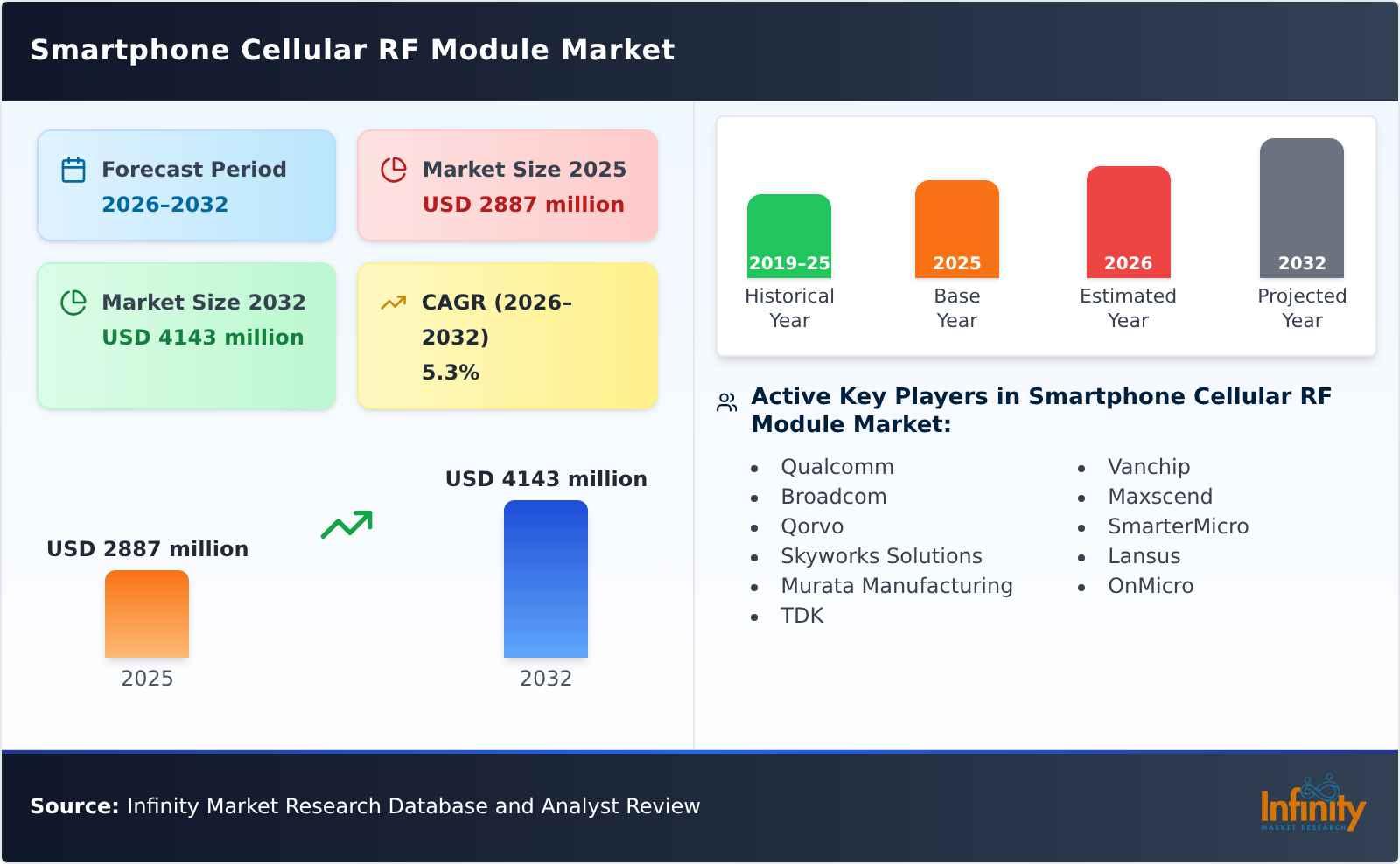
The global Smartphone Cellular RF Module market size is predicted to grow from US$ 2887 million in 2025 to US$ 4143 million in 2032; it is expected to grow at a CAGR of 5.3% from 2026 to 2032.
Explore this report in detail? Download a free sample copy
Download Free Sample Report
A smartphone cellular RF module refers to a module-level front-end unit integrated inside a handset that implements the radio-frequency transmit/receive signal chain for cellular communications. Centered around the RF outputs of the baseband/transceiver, it performs essential functions such as power amplification, low-noise receive amplification, RF switching and path selection, band filtering and harmonic suppression, antenna matching and tuning, and?under multi-antenna and carrier-aggregation use cases?multi-path parallelization and isolation management. Typical forms include power amplifier modules (PAM/PAMiD), front-end modules (FEM), filter modules, antenna tuning modules, or higher-integration ?RF front-end platform? combinations that interface with the main PCB, antenna system, and power-management circuitry. Its core purpose is to deliver manufacturable, certifiable, and repeatable RF performance?transmit power, linearity, noise figure, isolation, and out-of-band emissions suppression?within extremely tight constraints on size, thermal headroom, and battery budget, while coping with the growing number of bands, the wider bandwidth and higher PAPR characteristics of 5G NR that intensify the efficiency-versus-linearity trade-off, the inter-path interference introduced by carrier aggregation and dual connectivity, and the complex coexistence environment with Wi-Fi/Bluetooth/GNSS and other radios. Moduleization creates value by shifting process- and packaging-sensitive RF matching, shielding/isolation, thermal design, and consistency control upstream to the supplier, thereby reducing OEM risk and cycle time in RF layout, tuning, and certification, and improving yield and performance repeatability. Historically, early mobile phones assembled the RF front end from discrete PA, switch, and filter components placed on the mainboard; as smartphones evolved toward multi-band and multi-mode operation and 3G/4G expanded band counts under tighter board-area constraints, the industry moved steadily toward modular solutions (PAMs, FEMs, filter modules, etc.) to shrink footprint and improve reproducibility. From late-stage 4G into the 5G era, carrier aggregation, handset-level multi-antenna reception paths, and the higher power and wider bandwidth demands of 5G further accelerated platform-level integration and system optimization, including tighter coordination between PAs and power-management techniques (e.g., envelope tracking), more complex switch matrices and antenna tuning, and stronger end-to-end delivery spanning hardware, control algorithms, and validation collateral. Upstream, the supply chain covers materials and components such as semiconductor substrates and epitaxial wafers (silicon, gallium arsenide, and in some cases gallium nitride), photoresists, specialty gases and process chemicals, metallization and passivation materials; piezoelectric and wafer/material systems for acoustic-wave filters, high-frequency ceramics and metals; packaging and module assembly inputs including organic substrates/carriers, leadframes or flip-chip interconnect materials, solders and fluxes, molding and underfill compounds, EMI shields and absorbers, thermal interface materials and heat-spreading structures; and the key devices used within and around the module?PA and LNA dies, RF switches/tuners, filters/duplexers/multiplexers, passive matching networks (inductors/capacitors/resistors), sensing and control components for power/temperature monitoring, and connectors plus coax/board-level interconnects?culminating in handset-level RF calibration, performance consistency validation, carrier and regulatory certification, and high-volume manufacturing integration.In 2025, global capacity for smartphone cellular RF modules is estimated at 1.5 billion units, smartphone cellular RF module shipments are projected to reach 1.239 billion units, the average selling price is approximately USD 2.38 per unit, and leading suppliers are expected to achieve gross margins in the range of 50% to 70%.
United States market for Smartphone Cellular RF Module is estimated to increase from US$ million in 2025 to US$ million by 2032, at a CAGR of % from 2026 through 2032.
China market for Smartphone Cellular RF Module is estimated to increase from US$ million in 2025 to US$ million by 2032, at a CAGR of % from 2026 through 2032.
Europe market for Smartphone Cellular RF Module is estimated to increase from US$ million in 2025 to US$ million by 2032, at a CAGR of % from 2026 through 2032.
Global key Smartphone Cellular RF Module players cover Qualcomm, Broadcom, Qorvo, Skyworks Solutions, Murata Manufacturing, etc. In terms of revenue, the global two largest companies occupied for a share nearly % in 2025.
Infinity Market Research newest research report, the ?Smartphone Cellular RF Module Industry Forecast? looks at past sales and reviews total world Smartphone Cellular RF Module sales in 2025, providing a comprehensive analysis by region and market sector of projected Smartphone Cellular RF Module sales for 2026 through 2032. With Smartphone Cellular RF Module sales broken down by region, market sector and sub-sector, this report provides a detailed analysis in US$ millions of the world Smartphone Cellular RF Module industry.
This Insight Report provides a comprehensive analysis of the global Smartphone Cellular RF Module landscape and highlights key trends related to product segmentation, company formation, revenue, and market share, latest development, and M&A activity. This report also analyzes the strategies of leading global companies with a focus on Smartphone Cellular RF Module portfolios and capabilities, market entry strategies, market positions, and geographic footprints, to better understand these firms? unique position in an accelerating global Smartphone Cellular RF Module market.
This Insight Report evaluates the key market trends, drivers, and affecting factors shaping the global outlook for Smartphone Cellular RF Module and breaks down the forecast by Type, by Application, geography, and market size to highlight emerging pockets of opportunity. With a transparent methodology based on hundreds of bottom-up qualitative and quantitative market inputs, this study forecast offers a highly nuanced view of the current state and future trajectory in the global Smartphone Cellular RF Module.
This report presents a comprehensive overview, market shares, and growth opportunities of Smartphone Cellular RF Module market by product type, application, key manufacturers and key regions and countries.
Segmentation by Type:
PAMiF / PAMiD
DiFEM / L-DiFEM
ASM
Others
Segmentation by Frequency Band Coverage:
Sub-6G Only
Sub-6G + mmWave
Multi-band with CA Focus
Regional Band Variant
Segmentation by Device Technology:
CMOS/SOI-based
GaAs HBT-based
GaN-based
Segmentation by Application:
IOS System Mobile Phone
Android Mobile Phone
HarmonyOS Mobile Phone
Others
This report also splits the market by region:
Americas
United States
Canada
Mexico
Brazil
APAC
China
Japan
Korea
Southeast Asia
India
Australia
Europe
Germany
France
UK
Italy
Russia
Middle East & Africa
Egypt
South Africa
Israel
Turkey
GCC Countries
The below companies that are profiled have been selected based on inputs gathered from primary experts and analysing the companys coverage, product portfolio, its market penetration.
Qualcomm
Broadcom
Qorvo
Skyworks Solutions
Murata Manufacturing
TDK
Vanchip
Maxscend
SmarterMicro
Lansus
OnMicro
Key Questions Addressed in this Report
What is the 10-year outlook for the global Smartphone Cellular RF Module market?
What factors are driving Smartphone Cellular RF Module market growth, globally and by region?
Which technologies are poised for the fastest growth by market and region?
How do Smartphone Cellular RF Module market opportunities vary by end market size?
How does Smartphone Cellular RF Module break out by Type, by Application?
Smartphone Cellular RF Module Market Scope
| Report Attribute | Details |
|---|---|
| Market Size (Start Year) | USD XX Million |
| Market Size (End Year) | USD XX Million |
| Compound Annual Growth Rate (CAGR) | USD XX Million |
| Forecast Period | USD XX Million |
| Base Year | USD XX Million |
| Historical Data | USD XX Million |
| Key Players | USD XX Million |
REPORT COVERAGE
Revenue forecast, Company Analysis, Industry landscape, Growth factors, and Trends
SEGMENT COVERED
By component, deployment, organization size, application, and industry.
REGIONAL SCOPE
North America, Europe, Asia Pacific, Middle East & Africa, South & Central America
COUNTRY SCOPE
Includes key countries across all major regions.
Frequently Asked Questions
1. What is the market size of Global Smartphone Cellular RF Module Market?
Answer: The global Smartphone Cellular RF Module market size is predicted to grow from US$ 2887 million in 2025 to US$ 4143 million in 2032; it is expected to grow at a CAGR of 5.3% from 2026 to 2032.
2. Which regions are analyzed in the Global Smartphone Cellular RF Module Market report?
Answer: The Global Smartphone Cellular RF Module Market report covers major regions such as Europe, Middle East & Africa. Each region is analyzed for trends, opportunities, and market dynamics.
3. What methodology is used for forecasting of Global Smartphone Cellular RF Module Market?
Answer: The Global Smartphone Cellular RF Module Market report uses a mix of primary research, secondary data, and expert analysis.
4. Are emerging markets analyzed separately in the Global Smartphone Cellular RF Module Market?
Answer: Yes, the Global Smartphone Cellular RF Module Market report highlights high-growth emerging regions with dedicated insights.
5. Does the report include competitive benchmarking of Global Smartphone Cellular RF Module Market?
Answer: Yes, Global Smartphone Cellular RF Module Market report compares major players based on revenue, product portfolio, and innovation.
6. Can I access country-level data within the Global Smartphone Cellular RF Module Market report?
Answer: Yes, Global Smartphone Cellular RF Module Market report includes detailed data by country for major regions.
7. Can I get customized insights or data from the Global Smartphone Cellular RF Module Market report?
Answer: Yes, we offer customization options to align with your specific business needs. You can request tailored sections or regional breakdowns.