


Global Smartphone Wi-Fi Module Market Size, Share and Analysis Report 2026-2032
Mar 2026
Semiconductor and Electronics
Pages: 97
ILR4806
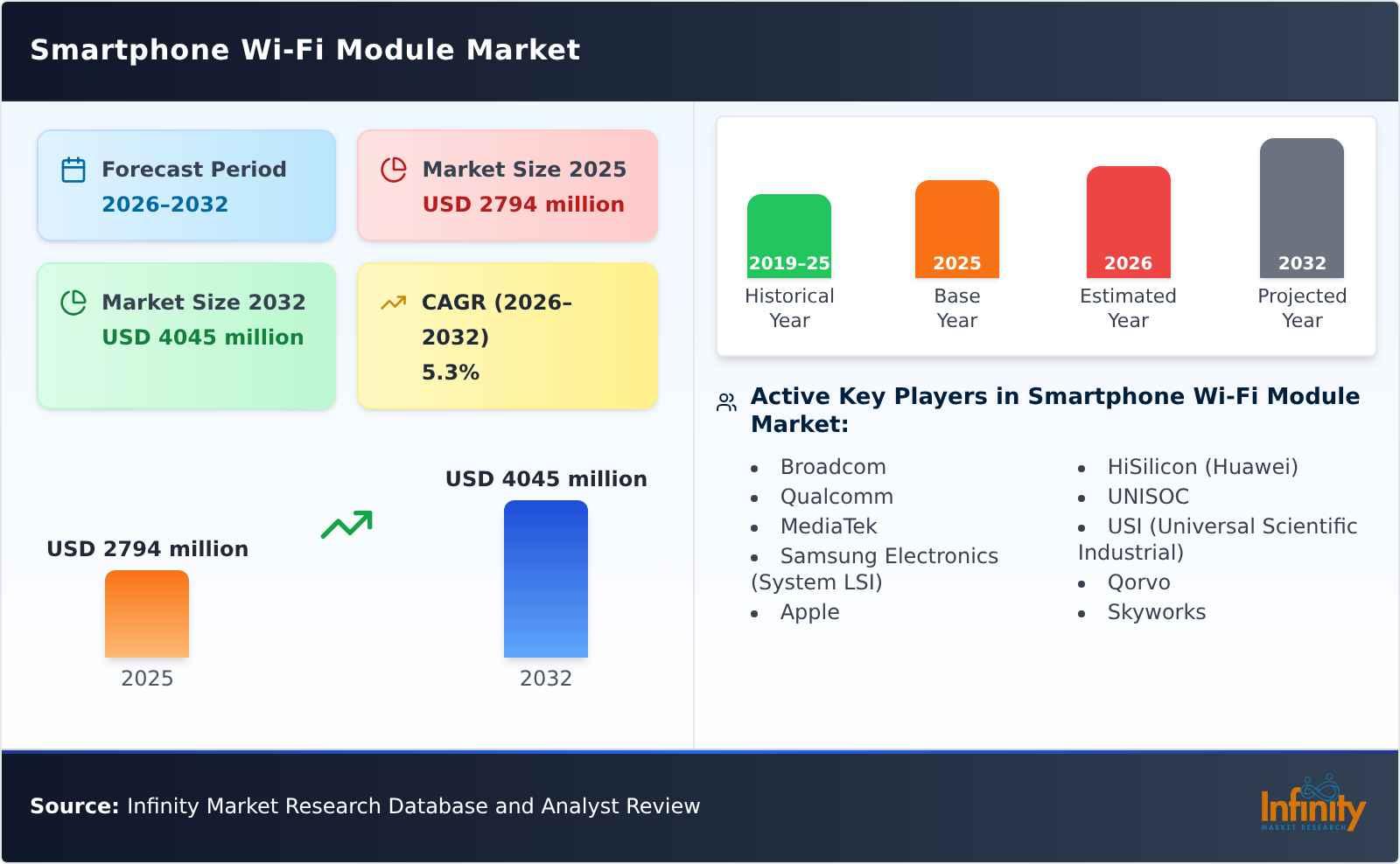
The global Smartphone Wi-Fi Module market size is predicted to grow from US$ 2794 million in 2025 to US$ 4045 million in 2032; it is expected to grow at a CAGR of 5.3% from 2026 to 2032.
Explore this report in detail? Download a free sample copy
Download Free Sample Report
A smartphone Wi-Fi module generally refers to a WLAN connectivity subsystem delivered as a ?drop-in functional unit? for direct integration into the handset. It typically comprises a Wi-Fi connectivity chip (often co-packaged or co-designed with Bluetooth), essential RF circuitry and power/clock support, selected passive components, and shielding and thermal structures, implemented in LGA/BGA packaging or as a SiP/compact module and mounted on the smartphone mainboard to operate in coordination with the primary platform via standard interfaces. Its core objective is to provide high-throughput, low-latency, and stable network access in indoor and short-range scenarios under the smartphone?s stringent constraints on space, power consumption, and thermal budget, while maintaining consistent user-perceived performance in complex electromagnetic environments and multi-device concurrency, and at the same time reducing OEM integration complexity and mass-production risk. By adopting a modular approach, RF matching, component selection, portions of tuning, and consistency control are shifted upstream to the supplier, which reduces uncertainty in PCB routing and antenna design, shortens validation cycles, and improves interoperability and regulatory certification success rates. Historically, early smartphones relied mainly on board-level integration of discrete connectivity chips and peripheral components; as dual-band operation became standard, data rates and concurrency requirements increased, and handset designs grew thinner, the supply chain gradually moved toward tighter packaging and standardized reference designs, evolving into semi-modular solutions based on combo chips with highly standardized surrounding components, and further into SiP or module delivery to improve consistency and reduce footprint. With the transition from Wi-Fi 5 to Wi-Fi 6/6E and the growing importance of system-level coordination?such as power management, congestion control, roaming experience, and radio coexistence algorithms?Wi-Fi modules increasingly emphasize integrated delivery of hardware, firmware, drivers, and test and certification support. Upstream, the supply chain spans raw materials and components including silicon wafers, photoresists, specialty gases and wet chemicals, and metallization materials for semiconductor manufacturing; organic substrates or carriers, solder balls and paste, molding and underfill compounds, EMI shielding and absorbing materials, and thermal interface materials for packaging and module assembly; as well as key devices and materials used within and around the module, such as RF components (power amplifiers, low-noise amplifiers, and switches), filters and passive matching networks (inductors and capacitors), timing devices (crystals and oscillators), power-management-related components, connectors and flexible printed circuits, and antenna and coaxial or board-level interconnects, culminating in antenna and RF tuning, interoperability testing, regulatory compliance, and high-volume manufacturing integration at the handset level.
In 2025, global capacity for smartphone Wi-Fi modules is estimated at 1.5 billion units, smartphone Wi-Fi module shipments are projected to reach 1.23 billion units, the average selling price is approximately USD 2.32 per unit, and leading suppliers are expected to achieve gross margins in the range of 49% to 63%.
United States market for Smartphone Wi-Fi Module is estimated to increase from US$ million in 2025 to US$ million by 2032, at a CAGR of % from 2026 through 2032.
China market for Smartphone Wi-Fi Module is estimated to increase from US$ million in 2025 to US$ million by 2032, at a CAGR of % from 2026 through 2032.
Europe market for Smartphone Wi-Fi Module is estimated to increase from US$ million in 2025 to US$ million by 2032, at a CAGR of % from 2026 through 2032.
Global key Smartphone Wi-Fi Module players cover Broadcom, Qualcomm, MediaTek, Samsung Electronics (System LSI), Apple, etc. In terms of revenue, the global two largest companies occupied for a share nearly % in 2025.
Infinity Market Research newest research report, the ?Smartphone Wi-Fi Module Industry Forecast? looks at past sales and reviews total world Smartphone Wi-Fi Module sales in 2025, providing a comprehensive analysis by region and market sector of projected Smartphone Wi-Fi Module sales for 2026 through 2032. With Smartphone Wi-Fi Module sales broken down by region, market sector and sub-sector, this report provides a detailed analysis in US$ millions of the world Smartphone Wi-Fi Module industry.
This Insight Report provides a comprehensive analysis of the global Smartphone Wi-Fi Module landscape and highlights key trends related to product segmentation, company formation, revenue, and market share, latest development, and M&A activity. This report also analyzes the strategies of leading global companies with a focus on Smartphone Wi-Fi Module portfolios and capabilities, market entry strategies, market positions, and geographic footprints, to better understand these firms? unique position in an accelerating global Smartphone Wi-Fi Module market.
This Insight Report evaluates the key market trends, drivers, and affecting factors shaping the global outlook for Smartphone Wi-Fi Module and breaks down the forecast by Type, by Application, geography, and market size to highlight emerging pockets of opportunity. With a transparent methodology based on hundreds of bottom-up qualitative and quantitative market inputs, this study forecast offers a highly nuanced view of the current state and future trajectory in the global Smartphone Wi-Fi Module.
This report presents a comprehensive overview, market shares, and growth opportunities of Smartphone Wi-Fi Module market by product type, application, key manufacturers and key regions and countries.
Segmentation by Type:
Wi?Fi 5
Wi?Fi 6/6E
Wi?Fi 7
Segmentation by Spatial Streams & PHY Capability:
1?1 MIMO
2?2 MIMO
Segmentation by Integration & Packaging Form:
SoC-integrated Wi-Fi Solution
Discrete Wi-Fi/Bluetooth Solution
Segmentation by Application:
IOS System Mobile Phone
Android Mobile Phone
HarmonyOS Mobile Phone
Others
This report also splits the market by region:
Americas
United States
Canada
Mexico
Brazil
APAC
China
Japan
Korea
Southeast Asia
India
Australia
Europe
Germany
France
UK
Italy
Russia
Middle East & Africa
Egypt
South Africa
Israel
Turkey
GCC Countries
The below companies that are profiled have been selected based on inputs gathered from primary experts and analysing the companys coverage, product portfolio, its market penetration.
Broadcom
Qualcomm
MediaTek
Samsung Electronics (System LSI)
Apple
HiSilicon (Huawei)
UNISOC
USI (Universal Scientific Industrial)
Qorvo
Skyworks
Key Questions Addressed in this Report
What is the 10-year outlook for the global Smartphone Wi-Fi Module market?
What factors are driving Smartphone Wi-Fi Module market growth, globally and by region?
Which technologies are poised for the fastest growth by market and region?
How do Smartphone Wi-Fi Module market opportunities vary by end market size?
How does Smartphone Wi-Fi Module break out by Type, by Application?
Smartphone Wi-Fi Module Market Scope
| Report Attribute | Details |
|---|---|
| Market Size (Start Year) | USD XX Million |
| Market Size (End Year) | USD XX Million |
| Compound Annual Growth Rate (CAGR) | USD XX Million |
| Forecast Period | USD XX Million |
| Base Year | USD XX Million |
| Historical Data | USD XX Million |
| Key Players | USD XX Million |
REPORT COVERAGE
Revenue forecast, Company Analysis, Industry landscape, Growth factors, and Trends
SEGMENT COVERED
By component, deployment, organization size, application, and industry.
REGIONAL SCOPE
North America, Europe, Asia Pacific, Middle East & Africa, South & Central America
COUNTRY SCOPE
Includes key countries across all major regions.
Frequently Asked Questions
1. What is the market size of Global Smartphone Wi-Fi Module Market?
Answer: The global Smartphone Wi-Fi Module market size is predicted to grow from US$ 2794 million in 2025 to US$ 4045 million in 2032; it is expected to grow at a CAGR of 5.3% from 2026 to 2032.
2. Which regions are analyzed in the Global Smartphone Wi-Fi Module Market report?
Answer: The Global Smartphone Wi-Fi Module Market report covers major regions such as Europe, Middle East & Africa. Each region is analyzed for trends, opportunities, and market dynamics.
3. What methodology is used for forecasting of Global Smartphone Wi-Fi Module Market?
Answer: The Global Smartphone Wi-Fi Module Market report uses a mix of primary research, secondary data, and expert analysis.
4. Are emerging markets analyzed separately in the Global Smartphone Wi-Fi Module Market?
Answer: Yes, the Global Smartphone Wi-Fi Module Market report highlights high-growth emerging regions with dedicated insights.
5. Does the report include competitive benchmarking of Global Smartphone Wi-Fi Module Market?
Answer: Yes, Global Smartphone Wi-Fi Module Market report compares major players based on revenue, product portfolio, and innovation.
6. Can I access country-level data within the Global Smartphone Wi-Fi Module Market report?
Answer: Yes, Global Smartphone Wi-Fi Module Market report includes detailed data by country for major regions.
7. Can I get customized insights or data from the Global Smartphone Wi-Fi Module Market report?
Answer: Yes, we offer customization options to align with your specific business needs. You can request tailored sections or regional breakdowns.