

Global SOFC Cogeneration System Market Trends, Growth and Outlook 2026-2032
Jan 2026
Energy and Power
Pages: 126
ILR2874
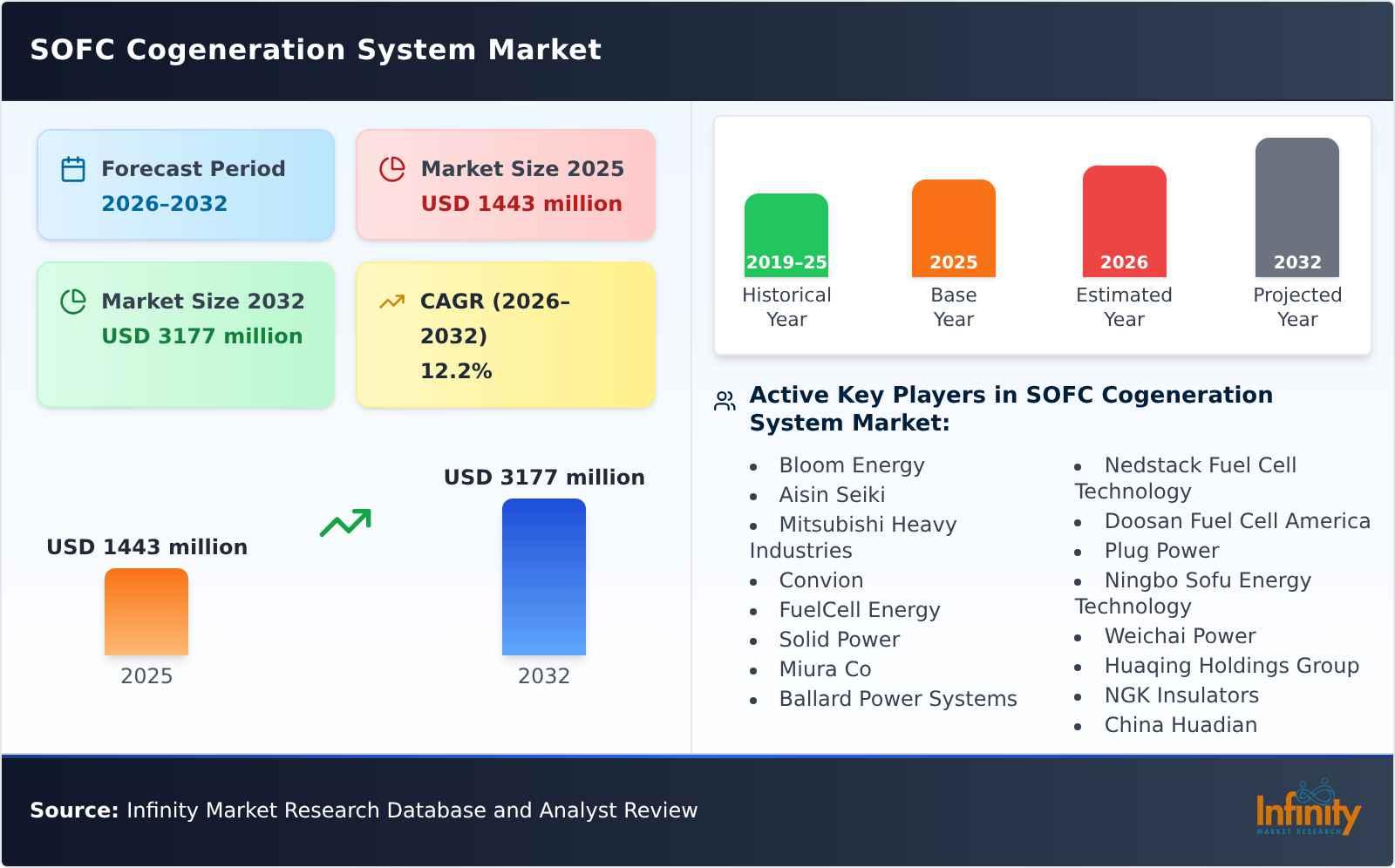
The global SOFC Cogeneration System market size is predicted to grow from US$ 1443 million in 2025 to US$ 3177 million in 2032; it is expected to grow at a CAGR of 12.2% from 2026 to 2032.
Explore this report in detail? Download a free sample copy
Download Free Sample Report
In 2024, the global production of SOFC (Solid Oxide Fuel Cell) cogeneration systems reached 1,800 units, with an average selling price of US$730,000 per unit.
SOFC cogeneration systems emerged to address the problems of low energy efficiency, high carbon emissions, and severe energy waste caused by the separation of power generation and heating in traditional energy systems. Since the breakthrough progress of SOFC technology in the 1990s, cogeneration systems have begun to integrate the high-efficiency power generation characteristics of SOFCs with waste heat recovery and utilization technologies, gradually developing into a comprehensive energy solution integrating power generation, heating, and cooling. Currently, SOFC (Solar-Oxygen-Fuel-Power) cogeneration systems have formed a comprehensive product system covering stationary, portable, and distributed types. They are widely used in industrial parks, commercial buildings, data centers, and power and heating scenarios in remote areas. Through electrochemical reactions, they directly convert the chemical energy of fuel into electrical energy (with an efficiency of 50%-60%), while simultaneously utilizing the waste heat from high-temperature exhaust gas for heating or driving absorption chillers. This increases the overall energy utilization rate to over 80%, significantly reducing energy costs and carbon emissions. It has become a key technology in the distributed energy sector for achieving dual-carbon goals, demonstrating significant advantages in improving energy efficiency, optimizing energy structure, and enhancing power supply reliability.
In 2024, the average price of SOFC (SOFC) combined heat and power systems globally varied significantly depending on power output: small commercial systems (1-100kW) averaged $80,000-$150,000 per unit; medium-sized distributed systems (100kW-1MW) averaged $500,000-$1,200,000 per unit; and large industrial systems (above 1MW) averaged $5,000,000-$8,000,000 per unit. In terms of production capacity, small and medium-sized enterprises typically have an annual production capacity of 200-500 units per line. The global industry average capacity utilization rate was approximately 62%, while in Europe and Asia, driven by policy, the utilization rate exceeded 75%. Gross profit margins varied depending on the application scenario: industrial-grade systems, due to high technological barriers, had gross profit margins of 35%-45%; while consumer micro-systems, due to intense competition, had gross profit margins of approximately 25%-30%.
Typical Transaction Cases: A chemical company in Germanys Ruhr industrial region purchased a 2MW SOFC (Solar-Fuel Combined Heat and Power) system from Siemens Energy in the third quarter of 2024, totaling approximately US$6.8 million. The technical requirements were clearly stated: Power generation efficiency ?60%, combined heat and power efficiency ?85%, compatible with natural gas-biomass gas mixed fuel (3:1 ratio), and able to connect to the companys existing steam network. This system was used for power supply and process steam supply in the synthetic ammonia production workshop, and was expected to reduce carbon dioxide emissions by 2,800 tons annually and lower energy costs by 22%.
A commercial complex in Tokyos Ginza district purchased a 100kW micro SOFC system from Mitsubishi Heavy Industries in early 2025, at a unit price of US$220,000. The requirements included: Start-stop response time ?30 minutes, operating noise ?55dB, winter heating/summer cooling switching efficiency ?90%. It was equipped with a smart energy management system and used for the malls daily power supply (accounting for 60% of total electricity consumption) and air conditioning needs, achieving an annual peak-valley electricity arbitrage profit of approximately US$180,000.
In the fourth quarter of 2024, a distributed energy project on an island in Sansha, Hainan, China, purchased a 500kW green hydrogen-compatible SOFC system from ENN Group, totaling US$1.9 million. The core requirements were: a split-type design, tolerance to high salt spray environments (corrosion level C5-M), ability to be linked with the islands wind power hydrogen production system, and a power supply reliability of ?99.5%. This system addresses the high cost and pollution issues of traditional diesel power generation on the island, replacing 1200 tons of diesel fuel annually.
The SOFC cogeneration systems industry chain encompasses upstream materials and components, midstream manufacturing and integration, and diversified downstream applications. The upstream core includes key materials such as electrolytes, electrodes, and connectors, accounting for 35% of the system cost (suppliers include NGK of Japan, ThyssenKrupp of Germany, and Taiyuan Iron & Steel of China), and components such as fuel cell stacks, accounting for 40% of the cost (manufacturers include Bloom Energy and Siemens Energy). Downstream applications are most prevalent in the industrial sector (chemicals, steel, etc.), accounting for up to 55%, with global industrial installed capacity increasing by 22% year-on-year in 2024. The commercial sector (large shopping malls, hotels) accounts for 25%, mainly used for energy self-sufficiency and peak-valley electricity arbitrage. Residential and distributed energy sectors each account for approximately 10%, serving energy supply for residential zero-carbon communities and special scenarios such as islands and mining areas, respectively.
Industry Trends and Challenges: The development trends of SOFC (Solar-Fuel Combined Heat and Power) systems are characterized by high power density upgrades (stack power density reaching 6kW/L by 2030, system volume reduced by 40%), green hydrogen adaptation (hydrogen fuel share increasing from 10% in 2024 to 35% in 2030, addressing green hydrogen supply fluctuations), modularization and standardization (100kW standard modules can be spliced, reducing construction time from 6 months to 2 months, and cost reduction by 25%), and widespread adoption of intelligent operation and maintenance (failure rate reduced by 18%, operation and maintenance costs reduced by 30%). Opportunities include policy dividends (Chinas 14th Five-Year Plan for 5GW installed capacity, EU 30% subsidy, US 30% tax credit), and industrial carbon reduction initiatives. Demand growth is driven by several factors: a 30%-40% reduction in emissions from the chemical/steel industry, with orders increasing by 45% year-on-year in 2024; the explosive growth of distributed energy (15% annual increase, suitable for urban/remote areas); and synergy in the green hydrogen industry (100 million tons of green hydrogen production capacity by 2030, forming a closed loop of production-storage-use). Challenges include high costs (US$3,000/kW, 2-3 times that of gas turbines), lifespan limitations (industrial-grade systems have a lifespan of 40,000 hours, with a target of 60,000 hours, and a 25% higher failure rate at low temperatures), insufficient fuel supply (green hydrogen accounts for only 0.1% of global hydrogen production, with transportation and storage costs accounting for 35%), and inconsistent standards (different certification standards across countries increase costs by 15%-20%).
Demand and Opportunity Analysis: Policy constraints (such as Chinas dual carbon targets and EU carbon tariffs), energy efficiency cost pressures (SOFCs overall efficiency of 75%-90% far exceeds traditional systems, with German chemical companies seeing a 22% annual cost reduction after application), and carbon asset returns (European carbon price of 90/ton, 1MW...). Driven by the annual carbon revenue of SOFC (180,000 euros) and energy security needs (adapting to multiple fuels to enhance resilience, with Germanys procurement increasing by 45% in 2024), SOFC cogeneration systems have formed five core business opportunities: the industrial substitution market (global stock exceeding 500GW, SOFC substitution potential of 100GW, single project exceeding US$5 million, gross profit margin of 40%), green hydrogen coupling projects (production and storage + cogeneration zero-carbon parks, ENN Groups Hebei demonstration project with a single investment of 200 million yuan, government subsidy of 30%, and a payback period of 6 years), and the popularization of the residential market (Japans 20... With a penetration rate of 20% over 30 years, driven by Chinas Beautiful Countryside initiative, Wuhans annual hydrogen power generation capacity reaches 100,000 units, with a unit price below US$10,000 and a scale exceeding US$5 billion. This, coupled with technology upgrade services (domestic production of core materials reducing costs by 30%, extending fuel cell stack lifespan to 50,000 hours, improving intelligent operation and maintenance efficiency by 5%, and achieving a gross profit margin of 45%), and international cooperation (20 projects along the Belt and Road with a total investment exceeding US$5 billion, exporting technical standards and solving local power grid coverage issues), has become a key technology and equipment for achieving efficient carbon reduction, improving energy utilization, and enhancing economic efficiency in the distributed energy sector.
Infinity Market Research newest research report, the SOFC Cogeneration System Industry Forecast looks at past sales and reviews total world SOFC Cogeneration System sales in 2025, providing a comprehensive analysis by region and market sector of projected SOFC Cogeneration System sales for 2026 through 2032. With SOFC Cogeneration System sales broken down by region, market sector and sub-sector, this report provides a detailed analysis in US$ millions of the world SOFC Cogeneration System industry.
This Insight Report provides a comprehensive analysis of the global SOFC Cogeneration System landscape and highlights key trends related to product segmentation, company formation, revenue, and market share, latest development, and M&A activity. This report also analyzes the strategies of leading global companies with a focus on SOFC Cogeneration System portfolios and capabilities, market entry strategies, market positions, and geographic footprints, to better understand these firms unique position in an accelerating global SOFC Cogeneration System market.
This Insight Report evaluates the key market trends, drivers, and affecting factors shaping the global outlook for SOFC Cogeneration System and breaks down the forecast by Type, by Application, geography, and market size to highlight emerging pockets of opportunity. With a transparent methodology based on hundreds of bottom-up qualitative and quantitative market inputs, this study forecast offers a highly nuanced view of the current state and future trajectory in the global SOFC Cogeneration System.
This report presents a comprehensive overview, market shares, and growth opportunities of SOFC Cogeneration System market by product type, application, key manufacturers and key regions and countries.
Segmentation by Type:
Small Systems (1-100kW)
Medium Systems (100kW-1MW)
Large Systems (1MW and above)
Segmentation by Fuel:
Natural Gas
Hydrogen
Biomass Gas
Syngas
Segmentation by System Integration:
Integrated
Split System
Segmentation by Application:
Industrial Sector
Commercial Sector
Residential Sector
Other
This report also splits the market by region:
Americas
United States
Canada
Mexico
Brazil
APAC
China
Japan
Korea
Southeast Asia
India
Australia
Europe
Germany
France
UK
Italy
Russia
Middle East & Africa
Egypt
South Africa
Israel
Turkey
GCC Countries
The below companies that are profiled have been selected based on inputs gathered from primary experts and analysing the companys coverage, product portfolio, its market penetration.
Bloom Energy
Aisin Seiki
Mitsubishi Heavy Industries
Convion
FuelCell Energy
Solid Power
Miura Co
Ballard Power Systems
Nedstack Fuel Cell Technology
Doosan Fuel Cell America
Plug Power
Ningbo Sofu Energy Technology
Weichai Power
Huaqing Holdings Group
NGK Insulators
China Huadian
Shanghai Electric
ENN Group
Wuhan Hydrogen Power Technology
Key Questions Addressed in this Report
What is the 10-year outlook for the global SOFC Cogeneration System market?
What factors are driving SOFC Cogeneration System market growth, globally and by region?
Which technologies are poised for the fastest growth by market and region?
How do SOFC Cogeneration System market opportunities vary by end market size?
How does SOFC Cogeneration System break out by Type, by Application?
SOFC Cogeneration System Market Scope
| Report Attribute | Details |
|---|---|
| Market Size (Start Year) | USD XX Million |
| Market Size (End Year) | USD XX Million |
| Compound Annual Growth Rate (CAGR) | USD XX Million |
| Forecast Period | USD XX Million |
| Base Year | USD XX Million |
| Historical Data | USD XX Million |
| Key Players | USD XX Million |
REPORT COVERAGE
Revenue forecast, Company Analysis, Industry landscape, Growth factors, and Trends
SEGMENT COVERED
By component, deployment, organization size, application, and industry.
REGIONAL SCOPE
North America, Europe, Asia Pacific, Middle East & Africa, South & Central America
COUNTRY SCOPE
Includes key countries across all major regions.
Frequently Asked Questions
1. What is the market size of Global SOFC Cogeneration System Market?
Answer: The global SOFC Cogeneration System market size is predicted to grow from US$ 1443 million in 2025 to US$ 3177 million in 2032; it is expected to grow at a CAGR of 12.2% from 2026 to 2032.
2. Which regions are analyzed in the Global SOFC Cogeneration System Market report?
Answer: The Global SOFC Cogeneration System Market report covers major regions such as Europe, Middle East & Africa. Each region is analyzed for trends, opportunities, and market dynamics.
3. What methodology is used for forecasting of Global SOFC Cogeneration System Market?
Answer: The Global SOFC Cogeneration System Market report uses a mix of primary research, secondary data, and expert analysis.
4. Are emerging markets analyzed separately in the Global SOFC Cogeneration System Market?
Answer: Yes, the Global SOFC Cogeneration System Market report highlights high-growth emerging regions with dedicated insights.
5. Does the report include competitive benchmarking of Global SOFC Cogeneration System Market?
Answer: Yes, Global SOFC Cogeneration System Market report compares major players based on revenue, product portfolio, and innovation.
6. Can I access country-level data within the Global SOFC Cogeneration System Market report?
Answer: Yes, Global SOFC Cogeneration System Market report includes detailed data by country for major regions.
7. Can I get customized insights or data from the Global SOFC Cogeneration System Market report?
Answer: Yes, we offer customization options to align with your specific business needs. You can request tailored sections or regional breakdowns.