


Global Spare Engine Leasing Market Size, Share and Analysis Report 2026-2032
Feb 2026
Information and Communication Technology
Pages: 133
ILR4578
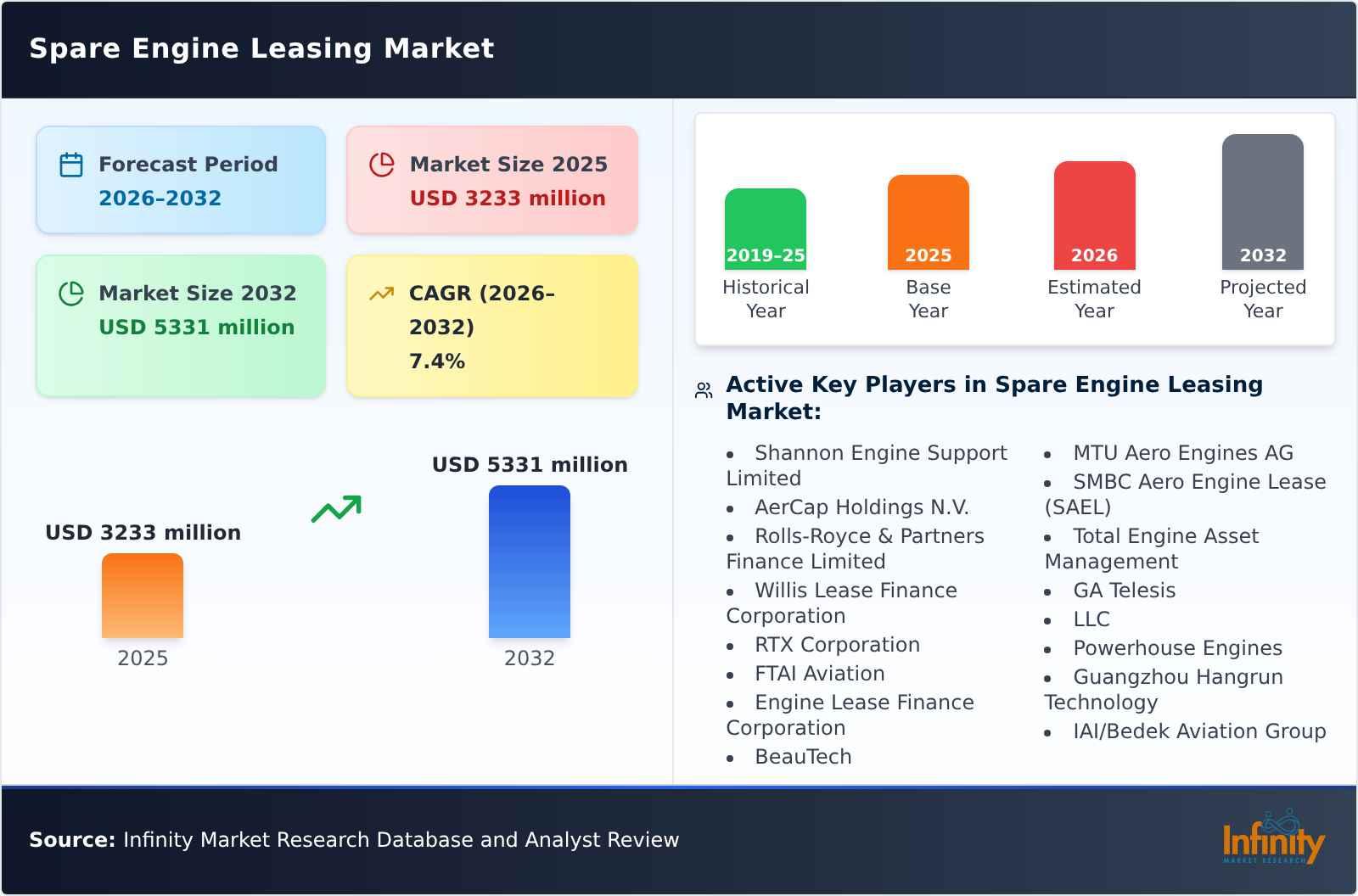
The global Spare Engine Leasing market size is predicted to grow from US$ 3233 million in 2025 to US$ 5331 million in 2032; it is expected to grow at a CAGR of 7.4% from 2026 to 2032.
Explore this report in detail? Download a free sample copy
Download Free Sample Report
Spare Engine Leasing refers to the leasing of serviceable aircraft spare engines?engines held outside the active operating fleet?by an engine owner/lessor to an airline or operator for a defined period, primarily to ensure fleet continuity during scheduled shop visits (MRO), unscheduled removals, or AOG events. The lease typically specifies the engine configuration and delivery timeline, allowable utilization limits (hours/cycles), maintenance responsibilities, and return condition/technical standards, and may be bundled with logistics and technical support as an integrated availability solution.
Spare engine leasing refers to the leasing of serviceable aircraft spare engines?typically held outside the active on-wing fleet?by an engine asset owner to airlines or operators for a defined period, in order to cover powerplant availability gaps caused by scheduled shop visits (MRO), unscheduled removals, and AOG events. The core value proposition is rapid engine replacement to reduce aircraft downtime and ensure operational continuity. Compared with aircraft leasing, this business is more availability- and turnaround-driven. Contract terms are therefore structured around engine configuration and airworthiness documentation, delivery lead time, utilization limits (hours/cycles), allocation of maintenance responsibilities, return condition standards, and compensation mechanisms, so as to clearly define risk and cost boundaries. On the demand side, airlines and operators are the primary users across narrowbody, widebody, and regional fleets, with short- to medium-term leases most concentrated in spare-engine use cases. First, maintenance windows and shop turnaround times create structurally persistent ?coverage gaps?; second, the uncertainty of failures and AOG events amplifies the need for contingency capacity. In practice, spare engine leasing is mainly deployed for (i) maintenance turnaround coverage, (ii) emergency replacement coverage, and (iii) fleet transition support. Customer decision-making prioritizes delivery speed, certainty of availability, and controllability of return conditions, rather than headline lease rates alone. On the supply side, the market is led by specialist engine lessors and aviation asset management platforms, alongside engine platforms operated by integrated aircraft lessors and capital providers such as bank-affiliated leasing companies and insurance capital participating through SPVs. From a product perspective, leases are typically segmented into short-term bridge leases, medium-term turnaround leases, and longer-term availability leases, and are often bundled with logistics, engine change support, technical assistance, and spare-pool management as integrated availability solutions. From a platform perspective, the business maps to narrowbody and widebody engine families: narrowbody assets are generally more standardized and scalable due to larger installed bases and higher liquidity, while widebody assets carry higher unit values and are more sensitive to maintenance events and residual-value management. In terms of cost structure, the industry combines high financial intensity with strong engineering and compliance requirements. Funding costs and depreciation/residual-value management form the earnings base, while maintenance reserves and return compensation, insurance and storage, airworthiness documentation and engineering support, cross-border logistics, and engine change activities drive project-level variability. Gross margin varies materially by engine platform, lease tenor, maintenance responsibility split, and return standards, with a typical industry range of 50%?75%. Short-term leases rely more on utilization and fast turnaround, whereas longer-term structures are more dependent on residual-value discipline and maintenance-responsibility design. If described using an ?operational single-line capacity? concept, a standardized turnaround support chain (asset management + airworthiness documentation + logistics + engineering support) can typically handle dozens to over a hundred engine ?lease-out?return?re-deployment? cycles per year, with bottlenecks most often arising from airworthiness documentation processing, engineering resource constraints, and cross-border logistics lead times. Upstream, the value chain is anchored by OEMs and the secondary supply ecosystem (including retirements, teardown, usable material, and overhaul resources). Midstream participants include engine lessors/asset management platforms and capital providers, while downstream demand is driven by airlines/operators and the MRO system. The competitive landscape features increasing concentration among specialist leaders and platform-based resource integration. Key barriers include asset sourcing and pricing, global re-marketing capability, maintenance event and residual-value management, engineering and compliance depth, and rapid-response delivery assurance. Going forward, the sector is expected to evolve from ?pure leasing? toward ?availability solutions,? leveraging digital asset management and predictive maintenance to improve uptime, expanding pool-sharing and service bundling to enhance turnaround efficiency, and strengthening lifecycle yield management through closer linkage with the secondary engine and used-material ecosystem.
LPI (LP Information) newest research report, the ?Spare Engine Leasing Industry Forecast? looks at past sales and reviews total world Spare Engine Leasing sales in 2025, providing a comprehensive analysis by region and market sector of projected Spare Engine Leasing sales for 2026 through 2032. With Spare Engine Leasing sales broken down by region, market sector and sub-sector, this report provides a detailed analysis in US$ millions of the world Spare Engine Leasing industry.
This Insight Report provides a comprehensive analysis of the global Spare Engine Leasing landscape and highlights key trends related to product segmentation, company formation, revenue, and market share, latest development, and M&A activity. This report also analyses the strategies of leading global companies with a focus on Spare Engine Leasing portfolios and capabilities, market entry strategies, market positions, and geographic footprints, to better understand these firms? unique position in an accelerating global Spare Engine Leasing market.
This Insight Report evaluates the key market trends, drivers, and affecting factors shaping the global outlook for Spare Engine Leasing and breaks down the forecast by Type, by Application, geography, and market size to highlight emerging pockets of opportunity. With a transparent methodology based on hundreds of bottom-up qualitative and quantitative market inputs, this study forecast offers a highly nuanced view of the current state and future trajectory in the global Spare Engine Leasing.
This report presents a comprehensive overview, market shares, and growth opportunities of Spare Engine Leasing market by product type, application, key players and key regions and countries.
Segmentation by Type:
CFM56-7B
CFM56-5B
V2500
Others
Segmentation by Lease Term:
Short-term Leasing
Medium-term Leasing
Long-term Leasing
Segmentation by Lease Structure:
Operating Leasing
Finance Leasing
Segmentation by Aircraft Type:
Narrow-Body
Wide-Body
Regional Jets
Others
Segmentation by Application:
Airlines
MRO Providers
Others
This report also splits the market by region:
Americas
United States
Canada
Mexico
Brazil
APAC
China
Japan
Korea
Southeast Asia
India
Australia
Europe
Germany
France
UK
Italy
Russia
Middle East & Africa
Egypt
South Africa
Israel
Turkey
GCC Countries
The below companies that are profiled have been selected based on inputs gathered from primary experts and analyzing the companys coverage, product portfolio, its market penetration.
Shannon Engine Support Limited
AerCap Holdings N.V.
Rolls-Royce & Partners Finance Limited
Willis Lease Finance Corporation
RTX Corporation
FTAI Aviation
Engine Lease Finance Corporation
BeauTech
MTU Aero Engines AG
SMBC Aero Engine Lease (SAEL)
Total Engine Asset Management
GA Telesis, LLC
Powerhouse Engines
Guangzhou Hangrun Technology
IAI/Bedek Aviation Group
BBAM
Jetran
Regional One, Inc.
KP Aviation
China Southern Air Leasing
Spare Engine Leasing Market Scope
| Report Attribute | Details |
|---|---|
| Market Size (Start Year) | USD XX Million |
| Market Size (End Year) | USD XX Million |
| Compound Annual Growth Rate (CAGR) | USD XX Million |
| Forecast Period | USD XX Million |
| Base Year | USD XX Million |
| Historical Data | USD XX Million |
| Key Players | USD XX Million |
REPORT COVERAGE
Revenue forecast, Company Analysis, Industry landscape, Growth factors, and Trends
SEGMENT COVERED
By component, deployment, organization size, application, and industry.
REGIONAL SCOPE
North America, Europe, Asia Pacific, Middle East & Africa, South & Central America
COUNTRY SCOPE
Includes key countries across all major regions.
Frequently Asked Questions
1. What is the market size of Global Spare Engine Leasing Market?
Answer: The global Spare Engine Leasing market size is predicted to grow from US$ 3233 million in 2025 to US$ 5331 million in 2032; it is expected to grow at a CAGR of 7.4% from 2026 to 2032.
2. Which regions are analyzed in the Global Spare Engine Leasing Market report?
Answer: The Global Spare Engine Leasing Market report covers major regions such as Europe, Middle East & Africa. Each region is analyzed for trends, opportunities, and market dynamics.
3. What methodology is used for forecasting of Global Spare Engine Leasing Market?
Answer: The Global Spare Engine Leasing Market report uses a mix of primary research, secondary data, and expert analysis.
4. Are emerging markets analyzed separately in the Global Spare Engine Leasing Market?
Answer: Yes, the Global Spare Engine Leasing Market report highlights high-growth emerging regions with dedicated insights.
5. Does the report include competitive benchmarking of Global Spare Engine Leasing Market?
Answer: Yes, Global Spare Engine Leasing Market report compares major players based on revenue, product portfolio, and innovation.
6. Can I access country-level data within the Global Spare Engine Leasing Market report?
Answer: Yes, Global Spare Engine Leasing Market report includes detailed data by country for major regions.
7. Can I get customized insights or data from the Global Spare Engine Leasing Market report?
Answer: Yes, we offer customization options to align with your specific business needs. You can request tailored sections or regional breakdowns.