


Global Stacked CMOS Image Sensor Market Growth 2026-2032
Jan 2026
Semiconductor and Electronics
Pages: 96
ILR1529
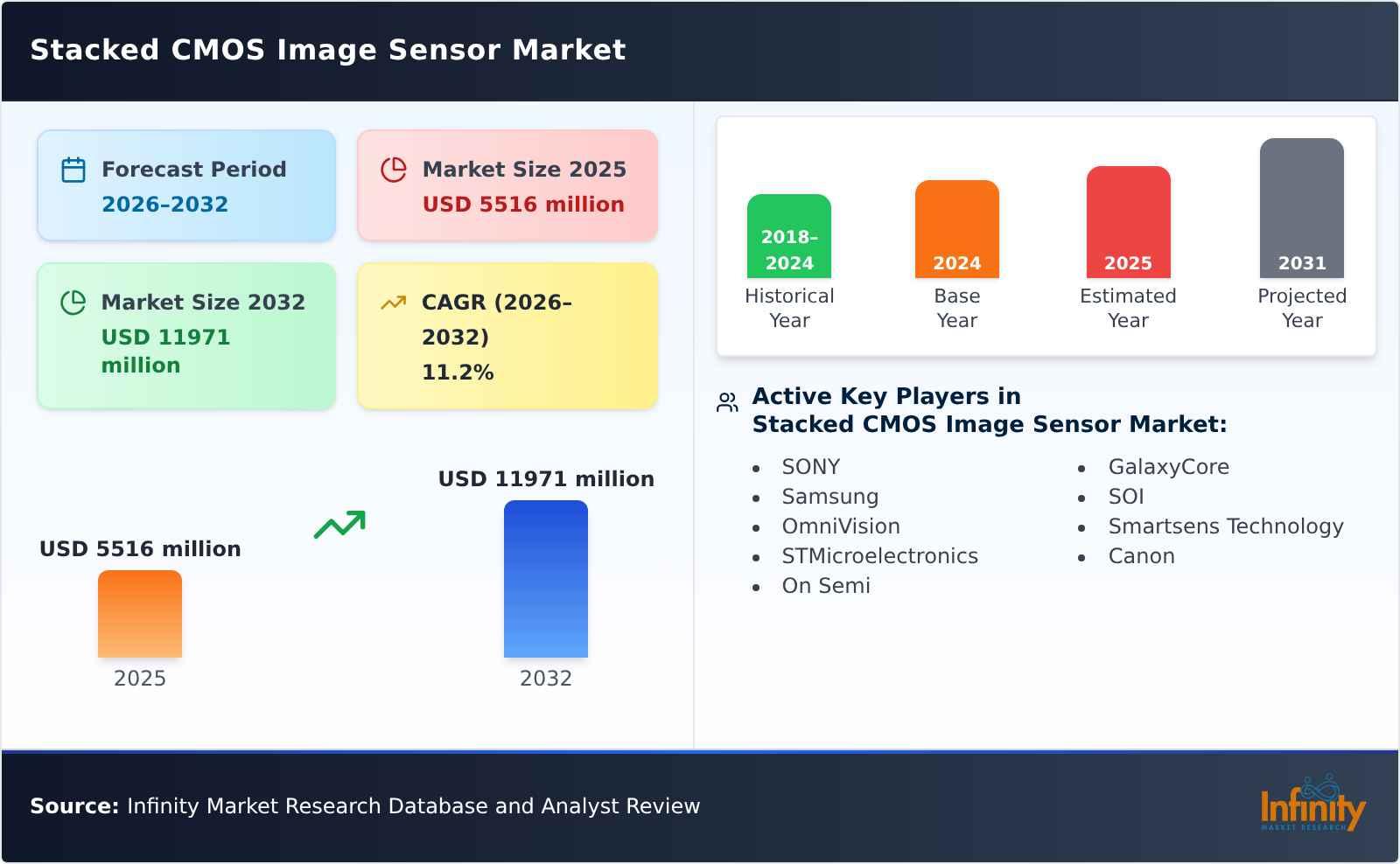
The global StackedCMOSImageSensor market size is predicted to grow from US$ 5516 million in 2025 to US$ 11971 million in 2032; it is expected to grow at a CAGR of 11.2% from 2026 to 2032.
Explore this report in detail? Download a free sample copy
Download Free Sample Report
In 2024, global Stack CMOS Image Sensor production reached approximately 1.55 billion Units, with an average global market price of around US$ 3.65 per unit.
A Stacked CMOS Image Sensor (Stacked CIS) is an upgraded architecture of CMOS image sensor, which realizes higher performance and smaller size by separating and stacking the two core functional modules of the sensor: the pixel array layer (responsible for photoelectric conversion) and the logic circuit layer (responsible for signal processing and readout). It is the mainstream architecture of high-performance CIS in current consumer electronics, automotive, and professional imaging fields.
The CMOS image sensor industry chain presents a vertical hierarchical structure with clear division of labor, spanning from upstream core material and equipment supply, midstream sensor design, manufacturing and packaging, to downstream application terminal integration. The industry has strong technical barriers, high concentration of leading enterprises, and close collaborative links between upstream and downstream links.
I. Upstream: Core Materials & Equipment (Technical Core, High Barriers)
The upstream segment provides the essential materials, equipment and intellectual property (IP) required for CIS design and manufacturing, and is the foundation of the entire industry chain. The market is dominated by a small number of international enterprises.
1. Core Materials
Semiconductor Wafer Substrate for CIS: chip manufacturing, the most critical material with the highest cost.
Photoresist: Key material for photolithography process, determines pixel precision.
Metal Target Material: Used for depositing metal wiring layers (e.g., copper, aluminum).
Packaging Materials: Include lead frames, encapsulants, bonding wires, etc.
2. Manufacturing Equipment
The equipment accounts for a large proportion of CIS production costs, and the core links are monopolized by overseas enterprises:
Photolithography Machine: The core equipment for pixel pattern transfer, directly determines the pixel size and sensor resolution. The leading enterprise is ASML (EUV lithography machines are used for advanced process CIS).
Etching Equipment: Used for pattern processing of wafer layers, with representatives such as Applied Materials, Tokyo Electron (TEL).
Deposition Equipment: For film deposition of various material layers, leading manufacturers include Applied Materials, TEL.
Testing Equipment: Used for performance testing of CIS chips, such as Teradyne, Advantest.
3. IP & Design Tools
IP Authorization: Core technologies such as pixel structure (BSI/Stacked), global shutter, and HDR algorithms are mostly held by professional IP companies, such as ARM, Synopsys, Cadence.
EDA Tools: Essential for CIS circuit design, the market is monopolized by Synopsys, Cadence, and Mentor Graphics.
II. Midstream: CIS Design, Manufacturing & Packaging (Value Core, High Concentration)
The midstream is the core value link of the industry chain, covering three key links: chip design, wafer fabrication, and packaging and testing. The industry is divided into two business models: IDM (Integrated Device Manufacturer) and Fabless + Foundry + OSAT.
1. Chip Design (Fabless/IDM Design Division)
The link determines the technical route and performance parameters of CIS (e.g., pixel structure, resolution, dynamic range). It has high R&D investment and strong technical barriers, and the market concentration is extremely high.
IDM Mode Enterprises: Integrate design, manufacturing, packaging and testing, with strong technical strength. Representative enterprises: Sony Semiconductor Solutions, Samsung Electronics, OmniVision (partially self-manufactured).
Fabless Mode Enterprises: Focus on design, outsource manufacturing and packaging to third parties. Representative enterprises: On Semiconductor, SK Hynix, GalaxyCore.
2. Wafer Fabrication (Foundry)
It is responsible for manufacturing CIS chips according to the design scheme, and the advanced process (e.g., 45nm, 28nm) is the key to improving sensor performance.
Main Foundries: TSMC (the largest foundry, focusing on high-end stacked CIS), UMC, GlobalFoundries, SMIC (focusing on mid-to-low-end CIS process).
IDM Self-Manufacturing Lines: Sony and Samsung have their own advanced wafer factories, which can realize the rapid iteration of proprietary technologies (e.g., Sonys Stacked CMOS).
3. Packaging and Testing (OSAT)
The link directly affects the reliability, size and heat dissipation performance of CIS, and the advanced packaging technology is the key to miniaturization and high performance.
Traditional Packaging: Includes wire bonding, encapsulation, etc., suitable for mid-to-low-end CIS, with manufacturers such as ASE Group, Amkor Technology.
Advanced Packaging: Flip-chip packaging (Flip Chip), wafer-level packaging (WLP), chip-scale packaging (CSP) are the mainstream, which can reduce the sensor size and improve the light sensitivity. Leading enterprises: ASE Group, Amkor, STATS ChipPAC.
Testing: Includes wafer testing (CP) and final testing (FT), to ensure the yield and performance consistency of CIS, with manufacturers such as Xcerra, Teradyne.
III. Downstream: Application Terminal Integration (Demand Core, Diversified Scenarios)
Downstream applications cover consumer electronics, automotive electronics, industrial detection, security monitoring, medical imaging and other fields. The demand of different scenarios drives the iteration of CIS technology, and the B2B field has become the main growth engine in recent years.
1. Consumer Electronics (Traditional Main Market, Gradual Saturation)
Application Scenarios: Smartphones (front and rear cameras), tablets, laptops, digital cameras, drones.
Demand Characteristics: Pursue high resolution (100MP+), small pixel size (0.7?m), stacked structure, but the market growth is slowing down with the saturation of smartphone shipments.
Key Customers: Apple, Samsung, Xiaomi, Huawei, DJI.
2. Automotive Electronics (Fastest Growing Track, High Barriers)
Application Scenarios: Vehicle-mounted cameras (front view, rear view, surround view, in-cabin monitoring), LiDAR supporting sensors, ADAS systems.
Demand Characteristics: Need to meet AEC-Q100 automotive-grade certification, with high requirements for high temperature resistance, anti-electromagnetic interference, high dynamic range (HDR > 120dB) and reliability. The single-vehicle CIS loading quantity can reach 8-16 units with the upgrade of autonomous driving.
Key Customers: Tesla, BYD, Volkswagen, Bosch, Continental.
3. Security Monitoring (Stable Demand, High Performance Requirements)
Application Scenarios: Network cameras (IPC), analog cameras, ball machines, video recorders (NVR).
Demand Characteristics: Emphasize low illumination imaging ability, wide dynamic range, and night vision effect. 4K high-definition and AI intelligent recognition are the main trends.
Key Customers: Hikvision, Dahua Technology, Uniview.
4. Industrial & Medical Fields (High Profit Margin, Professional Demand)
Industrial Detection: Machine vision cameras, semiconductor detection equipment, barcode scanners, requiring global shutter, high frame rate (thousands of frames/second) and high precision. Key customers: Keyence, Cognex.
Medical Imaging: Endoscopes, dental imaging equipment, portable detectors, requiring high signal-to-noise ratio, low radiation and miniaturization. Key customers: Olympus, Fujifilm.
IV. Industry Chain Characteristics & Profit Distribution
Profit Concentration: The upstream equipment and midstream design links occupy the highest profit margin, while the downstream application terminal profit margin is relatively low.
Technical Synergy: The iteration of downstream application demand (e.g., automotive high dynamic range, industrial global shutter) drives the R&D of midstream design and upstream material and equipment technologies, forming a positive feedback loop.
Regional Concentration: The upstream and midstream high-end links are concentrated in Japan, South Korea, the United States and Taiwan of China; the downstream application market is dominated by China, which is the largest CIS consumer market in the world.
Infinity Market Research newest research report, the StackedCMOSImageSensor Industry Forecast looks at past sales and reviews total world StackedCMOSImageSensor sales in 2025, providing a comprehensive analysis by region and market sector of projected StackedCMOSImageSensor sales for 2026 through 2032. With StackedCMOSImageSensor sales broken down by region, market sector and sub-sector, this report provides a detailed analysis in US$ millions of the world StackedCMOSImageSensor industry.
This Insight Report provides a comprehensive analysis of the global StackedCMOSImageSensor landscape and highlights key trends related to product segmentation, company formation, revenue, and market share, latest development, and M&A activity. This report also analyzes the strategies of leading global companies with a focus on StackedCMOSImageSensor portfolios and capabilities, market entry strategies, market positions, and geographic footprints, to better understand these firms unique position in an accelerating global StackedCMOSImageSensor market.
This Insight Report evaluates the key market trends, drivers, and affecting factors shaping the global outlook for StackedCMOSImageSensor and breaks down the forecast by Type, by Application, geography, and market size to highlight emerging pockets of opportunity. With a transparent methodology based on hundreds of bottom-up qualitative and quantitative market inputs, this study forecast offers a highly nuanced view of the current state and future trajectory in the global StackedCMOSImageSensor.
This report presents a comprehensive overview, market shares, and growth opportunities of StackedCMOSImageSensor market by product type, application, key manufacturers and key regions and countries.
Segmentation by Type:
12MP
26MP
Others
Segmentation by Stacking Layer Count:
2?Stack CIS
3?Stack CIS
Multi?Stack CIS (?4 layers)
Segmentation by Bonding Technology:
Micro?bump Bonding
Cu?Cu Hybrid Bonding
Through?Silicon Vias (TSV) Bonding
Segmentation by Application:
Mobile Phone
Automobile
Others
This report also splits the market by region:
Americas
United States
Canada
Mexico
Brazil
APAC
China
Japan
Korea
Southeast Asia
India
Australia
Europe
Germany
France
UK
Italy
Russia
Middle East & Africa
Egypt
South Africa
Israel
Turkey
GCC Countries
The below companies that are profiled have been selected based on inputs gathered from primary experts and analysing the companys coverage, product portfolio, its market penetration.
SONY
Samsung
OmniVision
STMicroelectronics
On Semi
GalaxyCore
SOI
Smartsens Technology
Canon
Key Questions Addressed in this Report
What is the 10-year outlook for the global StackedCMOSImageSensor market?
What factors are driving StackedCMOSImageSensor market growth, globally and by region?
Which technologies are poised for the fastest growth by market and region?
How do StackedCMOSImageSensor market opportunities vary by end market size?
How does StackedCMOSImageSensor break out by Type, by Application?
Stacked CMOS Image Sensor Market Scope
| Report Attribute | Details |
|---|---|
| Market Size (Start Year) | USD XX Million |
| Market Size (End Year) | USD XX Million |
| Compound Annual Growth Rate (CAGR) | USD XX Million |
| Forecast Period | USD XX Million |
| Base Year | USD XX Million |
| Historical Data | USD XX Million |
| Key Players | USD XX Million |
REPORT COVERAGE
Revenue forecast, Company Analysis, Industry landscape, Growth factors, and Trends
SEGMENT COVERED
By component, deployment, organization size, application, and industry.
REGIONAL SCOPE
North America, Europe, Asia Pacific, Middle East & Africa, South & Central America
COUNTRY SCOPE
Includes key countries across all major regions.
Frequently Asked Questions
1. What is the market size of Global Stacked CMOS Image Sensor Market?
Answer: The global StackedCMOSImageSensor market size is predicted to grow from US$ 5516 million in 2025 to US$ 11971 million in 2032; it is expected to grow at a CAGR of 11.2% from 2026 to 2032.
2. Which regions are analyzed in the Global Stacked CMOS Image Sensor Market report?
Answer: The Global Stacked CMOS Image Sensor Market report covers major regions such as Europe, Middle East & Africa. Each region is analyzed for trends, opportunities, and market dynamics.
3. What methodology is used for forecasting of Global Stacked CMOS Image Sensor Market?
Answer: The Global Stacked CMOS Image Sensor Market report uses a mix of primary research, secondary data, and expert analysis.
4. Are emerging markets analyzed separately in the Global Stacked CMOS Image Sensor Market?
Answer: Yes, the Global Stacked CMOS Image Sensor Market report highlights high-growth emerging regions with dedicated insights.
5. Does the report include competitive benchmarking of Global Stacked CMOS Image Sensor Market?
Answer: Yes, Global Stacked CMOS Image Sensor Market report compares major players based on revenue, product portfolio, and innovation.
6. Can I access country-level data within the Global Stacked CMOS Image Sensor Market report?
Answer: Yes, Global Stacked CMOS Image Sensor Market report includes detailed data by country for major regions.
7. Can I get customized insights or data from the Global Stacked CMOS Image Sensor Market report?
Answer: Yes, we offer customization options to align with your specific business needs. You can request tailored sections or regional breakdowns.