


Global Trichromatic Phosphor for Lamps Market Growth 2026-2032
Jan 2026
Chemicals and Materials
Pages: 124
ILR1450
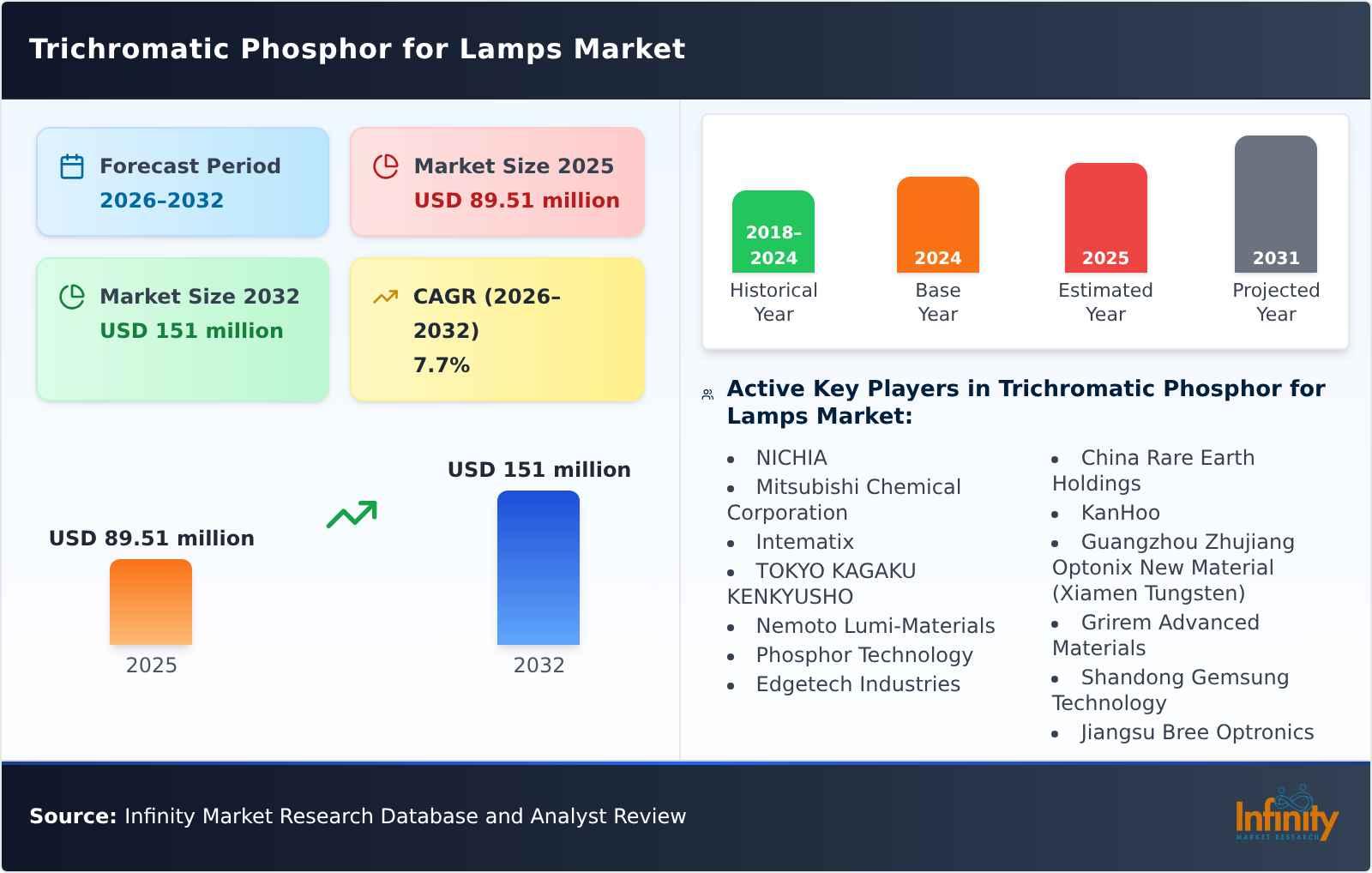
The global Trichromatic Phosphor for Lamps market size is predicted to grow from US$ 89.51 million in 2025 to US$ 151 million in 2032; it is expected to grow at a CAGR of 7.7% from 2026 to 2032.
Explore this report in detail? Download a free sample copy
Download Free Sample Report
In 2025, global sales of Trichromatic Phosphor for Lamps reached approximately 15 k tons, with an average market price of about USD 6100 per ton, an annual production capacity of roughly 20 k tons, and an industry-average gross margin of approximately 20%.
Trichromatic Phosphor for Lamps are a class of rare-earth phosphor systems that emit narrow-band red, green, and blue primary colors, which are blended in defined ratios to produce high-color-rendering white light. Typical formulations use rare-earth-activated inorganic hosts, such as Eu?-activated red phosphates, Tb? or Ce?/Tb?-activated green silicates/borates, and blue aluminates or silicates such as BaMgAl??O??:Eu?. The different color powders are coated on the inner wall of fluorescent tubes or CFL bulbs; when excited by ultraviolet radiation from mercury discharge, they emit visible light, enabling high luminous efficacy, high color rendering index (CRI), and tunable correlated color temperature. These materials are widely used in conventional fluorescent lighting and some backlighting applications.
On the upstream side, Trichromatic Phosphor for Lamps rely heavily on rare-earth raw materials and inorganic chemical feedstocks, including rare-earth oxides such as yttrium oxide, europium oxide, and terbium oxide, as well as inorganic salts and host materials containing aluminum, barium, calcium, magnesium, and others. Key players usually master powder synthesis, calcination, coating, and particle-size control technologies. The midstream segment is composed of specialized phosphor manufacturers and some vertically integrated rare-earth groups that develop full product lines and supply lamp and light-source makers. Downstream, consumption is driven mainly by fluorescent tube, compact fluorescent lamp (CFL), specialty lamp, and certain backlight module manufacturers; their trichromatic phosphor usage is directly linked to the installed base and replacement demand for conventional fluorescent lighting worldwide. With general lighting shifting to LEDs, ongoing consumption is now concentrated in maintenance of legacy installations, industrial applications, and specialized lighting niches.
TheTrichromatic Phosphor for Lamps market today sits in a classic mature but still strategic position within the broader lighting materials landscape. Demand has structurally declined as LED lighting replaces traditional fluorescent and compact fluorescent lamps, where tri-band phosphors were the core enabling material for high-CRI white light, and this is reflected in shrinking new-build lamp production and growing emphasis on cost control and recycling of rare-earth-containing powders. At the same time, the segment remains technically important: tri-phosphor formulations and know-how continue to be used in legacy fluorescent infrastructure, specialty and industrial lamps, and as a knowledge base feeding into next-generation phosphor development for LEDs and displays. The market structure is highly concentrated, dominated by a few global rare-earth and lighting-material suppliers with strong IP portfolios, integrated access to rare-earth oxides, and close ties to major lamp manufacturers, while smaller regional players focus on toll processing, niche formulations, and serving local maintenance markets.
Infinity Market Research newest research report, the Trichromatic Phosphor for Lamps Industry Forecast looks at past sales and reviews total world Trichromatic Phosphor for Lamps sales in 2025, providing a comprehensive analysis by region and market sector of projected Trichromatic Phosphor for Lamps sales for 2026 through 2032. With Trichromatic Phosphor for Lamps sales broken down by region, market sector and sub-sector, this report provides a detailed analysis in US$ millions of the world Trichromatic Phosphor for Lamps industry.
This Insight Report provides a comprehensive analysis of the global Trichromatic Phosphor for Lamps landscape and highlights key trends related to product segmentation, company formation, revenue, and market share, latest development, and M&A activity. This report also analyzes the strategies of leading global companies with a focus on Trichromatic Phosphor for Lamps portfolios and capabilities, market entry strategies, market positions, and geographic footprints, to better understand these firms unique position in an accelerating global Trichromatic Phosphor for Lamps market.
This Insight Report evaluates the key market trends, drivers, and affecting factors shaping the global outlook for Trichromatic Phosphor for Lamps and breaks down the forecast by Type, by Application, geography, and market size to highlight emerging pockets of opportunity. With a transparent methodology based on hundreds of bottom-up qualitative and quantitative market inputs, this study forecast offers a highly nuanced view of the current state and future trajectory in the global Trichromatic Phosphor for Lamps.
This report presents a comprehensive overview, market shares, and growth opportunities of Trichromatic Phosphor for Lamps market by product type, application, key manufacturers and key regions and countries.
Segmentation by Type:
Red Powder
Green Powder
Blue Powder
Mixed Powder
Segmentation by Matrix:
Phosphate-based
Aluminate-based
Silicate-based
Borate
Segmentation by Technologies:
Single-Phase White Phosphors
Thermal-Optical Coupling
Segmentation by Application:
LED Lighting
Energy-Saving Lamps
Others
This report also splits the market by region:
Americas
United States
Canada
Mexico
Brazil
APAC
China
Japan
Korea
Southeast Asia
India
Australia
Europe
Germany
France
UK
Italy
Russia
Middle East & Africa
Egypt
South Africa
Israel
Turkey
GCC Countries
The below companies that are profiled have been selected based on inputs gathered from primary experts and analysing the companys coverage, product portfolio, its market penetration.
NICHIA
Mitsubishi Chemical Corporation
Intematix
TOKYO KAGAKU KENKYUSHO
Nemoto Lumi-Materials
Phosphor Technology
Edgetech Industries
China Rare Earth Holdings
KanHoo
Guangzhou Zhujiang Optonix New Material (Xiamen Tungsten)
Grirem Advanced Materials
Shandong Gemsung Technology
Jiangsu Bree Optronics
Key Questions Addressed in this Report
What is the 10-year outlook for the global Trichromatic Phosphor for Lamps market?
What factors are driving Trichromatic Phosphor for Lamps market growth, globally and by region?
Which technologies are poised for the fastest growth by market and region?
How do Trichromatic Phosphor for Lamps market opportunities vary by end market size?
How does Trichromatic Phosphor for Lamps break out by Type, by Application?
Trichromatic Phosphor for Lamps Market Scope
| Report Attribute | Details |
|---|---|
| Market Size (Start Year) | USD XX Million |
| Market Size (End Year) | USD XX Million |
| Compound Annual Growth Rate (CAGR) | USD XX Million |
| Forecast Period | USD XX Million |
| Base Year | USD XX Million |
| Historical Data | USD XX Million |
| Key Players | USD XX Million |
REPORT COVERAGE
Revenue forecast, Company Analysis, Industry landscape, Growth factors, and Trends
SEGMENT COVERED
By component, deployment, organization size, application, and industry.
REGIONAL SCOPE
North America, Europe, Asia Pacific, Middle East & Africa, South & Central America
COUNTRY SCOPE
Includes key countries across all major regions.
Frequently Asked Questions
1. What is the market size of Global Trichromatic Phosphor for Lamps Market?
Answer: The global Trichromatic Phosphor for Lamps market size is predicted to grow from US$ 89.51 million in 2025 to US$ 151 million in 2032; it is expected to grow at a CAGR of 7.7% from 2026 to 2032.
2. Which regions are analyzed in the Global Trichromatic Phosphor for Lamps Market report?
Answer: The Global Trichromatic Phosphor for Lamps Market report covers major regions such as Europe, Middle East & Africa. Each region is analyzed for trends, opportunities, and market dynamics.
3. What methodology is used for forecasting of Global Trichromatic Phosphor for Lamps Market?
Answer: The Global Trichromatic Phosphor for Lamps Market report uses a mix of primary research, secondary data, and expert analysis.
4. Are emerging markets analyzed separately in the Global Trichromatic Phosphor for Lamps Market?
Answer: Yes, the Global Trichromatic Phosphor for Lamps Market report highlights high-growth emerging regions with dedicated insights.
5. Does the report include competitive benchmarking of Global Trichromatic Phosphor for Lamps Market?
Answer: Yes, Global Trichromatic Phosphor for Lamps Market report compares major players based on revenue, product portfolio, and innovation.
6. Can I access country-level data within the Global Trichromatic Phosphor for Lamps Market report?
Answer: Yes, Global Trichromatic Phosphor for Lamps Market report includes detailed data by country for major regions.
7. Can I get customized insights or data from the Global Trichromatic Phosphor for Lamps Market report?
Answer: Yes, we offer customization options to align with your specific business needs. You can request tailored sections or regional breakdowns.