


Global Urokinase for Injection Market Growth 2026-2032
Jan 2026
Healthcare
Pages: 105
ILR1225
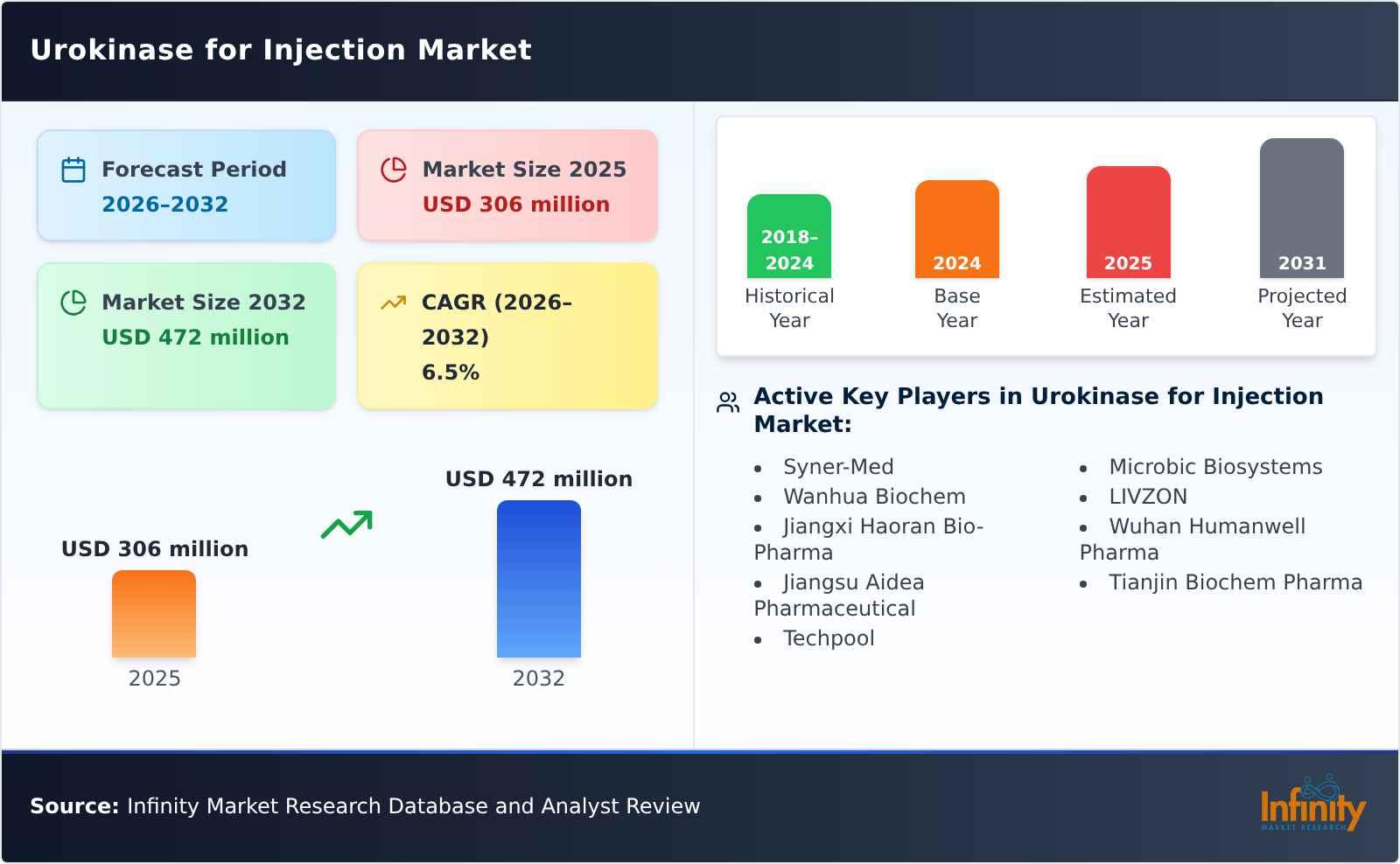
The global Urokinase for Injection market size is predicted to grow from US$ 306 million in 2025 to US$ 472 million in 2032; it is expected to grow at a CAGR of 6.5% from 2026 to 2032.
Explore this report in detail? Download a free sample copy
Download Free Sample Report
The urokinase injection market refers to the clinical and commercial use of injectable urokinase (urokinase for injection)a clot-dissolving medicine used in hospitals to break down unwanted blood clots. Urokinase works by acting on the bodys natural fibrinolytic system: it converts plasminogen into plasmin, and plasmin then breaks down fibrin clots (and also affects fibrinogen and some other plasma proteins). Because urokinase is given by injection/infusion and can cause serious bleeding, its use is typically limited to settings where doctors can monitor patients closely (emergency departments, intensive care units, catheter labs, interventional radiology suites, vascular surgery wards, and specialized stroke or thrombosis centers).
In practical terms, the market is defined by where and how urokinase injection is used. In some jurisdictions, product labeling and clinical practice include use for pulmonary embolism (blood clots in the lungs), for catheter-directed thrombolysis in peripheral arteries or graft occlusions, and for restoring patency of intravenous catheters blocked by clotted blood or fibrin. This hospital procedure drug positioning is important: urokinase injection is not a long-term prevention drug like oral anticoagulants; it is more often a time-sensitive rescue therapy or a procedure-support drug used when a clot is already causing acute risk or blocking a device.
A key part of the market definition is also the dosage form and supply chain. Urokinase products are commonly supplied as a sterile lyophilized (freeze-dried) powder that must be reconstituted before use. These factors make urokinase different from many small-molecule injectables: producers must manage complex upstream cell culture, purification, sterile fill-finish, and strict quality control, and buyers care about lot consistency and supply reliability.
In 2025, global Urokinase for Injection production reached approximately 15.6 million Units, with an average global market price of around US$ 20.1 per Units. The global single-line production capacity ranges from 350 to 500 K Units per year. The industrys gross profit margin is approximately 25%-35%.
On market trends, one broad trend is that thrombolysis is being shaped by newer thrombolytic agents, improved imaging, and more interventional procedures. In acute ischemic stroke, for example, many global guidelines focus on intravenous alteplase (and increasingly tenecteplase as an alternative in some systems) within defined time windows, and mechanical thrombectomy has expanded in selected patients. This matters for urokinase because it changes where urokinase is positioned: in many countries, urokinase is not the primary stroke thrombolytic, while in others it is used as a lower-cost or locally available option. A recent review notes that urokinase has been approved and used in China for years and that Chinese guidance has recommended intravenous urokinase within certain time windows for acute ischemic stroke, with commonly cited dosing ranges (for example 1,000,0001,500,000 IU in that context). So, the stroke segment shows a two-track trend: in some regions, practice is consolidating around rt-PA/tenecteplase and thrombectomy pathways, while in other regions, urokinase remains relevant due to access, cost, and local evidence bases.
A second trend is the growth of catheter use in modern medicine, which tends to expand the catheter-clearance opportunity for thrombolytics, including urokinase. Central venous catheters and other long-term lines are widely used for chemotherapy, parenteral nutrition, long courses of IV antibiotics, and repeated blood draws. The clinical literature describes catheter occlusion as a frequent complication and reviews thrombolytic options for restoring patency. In that review, several thrombolytic agents (including recombinant urokinase) are discussed with reported catheter clearance rates and time-to-clearance outcomes, and the paper also notes that thrombolytic prophylaxis in some studies reduced catheter occlusion incidence. Even if individual studies vary, the practical market implication is straightforward: as the number of patients dependent on long-term catheters rises (cancer care, home infusion, complex pediatrics, dialysis pathways), hospitals place higher value on reliable, fast methods to reopen lines and avoid line replacement procedures.
A third trend is a procedural shift toward targeted therapy in vascular care. For some vascular occlusions, clinicians may prefer catheter-directed approaches that localize treatment at the clot, often aiming to improve efficacy while limiting systemic exposure and bleeding risk. Urokinase has a history of use in catheter-directed settings (for example, peripheral arterial and graft thromboembolic occlusion described in product monographs). At the same time, competition is intense: other thrombolytics (alteplase, tenecteplase, reteplase in certain contexts) and mechanical strategies (aspiration, thrombectomy devices, angioplasty/stenting) all influence whether a hospital uses urokinase, which dose, and for which patients. This competitive pressure pushes the urokinase market toward niches where it has clear operational or economic advantages (availability, protocol familiarity, cost, or suitability for a specific catheter-clearance workflow).
Infinity Market Research newest research report, the Urokinase for Injection Industry Forecast looks at past sales and reviews total world Urokinase for Injection sales in 2025, providing a comprehensive analysis by region and market sector of projected Urokinase for Injection sales for 2026 through 2032. With Urokinase for Injection sales broken down by region, market sector and sub-sector, this report provides a detailed analysis in US$ millions of the world Urokinase for Injection industry.
This Insight Report provides a comprehensive analysis of the global Urokinase for Injection landscape and highlights key trends related to product segmentation, company formation, revenue, and market share, latest development, and M&A activity. This report also analyzes the strategies of leading global companies with a focus on Urokinase for Injection portfolios and capabilities, market entry strategies, market positions, and geographic footprints, to better understand these firms unique position in an accelerating global Urokinase for Injection market.
This Insight Report evaluates the key market trends, drivers, and affecting factors shaping the global outlook for Urokinase for Injection and breaks down the forecast by Type, by Application, geography, and market size to highlight emerging pockets of opportunity. With a transparent methodology based on hundreds of bottom-up qualitative and quantitative market inputs, this study forecast offers a highly nuanced view of the current state and future trajectory in the global Urokinase for Injection.
This report presents a comprehensive overview, market shares, and growth opportunities of Urokinase for Injection market by product type, application, key manufacturers and key regions and countries.
Segmentation by Type:
10000-100000IU
100000-1000000IU
Others
Segmentation by Clinical Use:
Pulmonary Embolism Thrombolysis
Deep Vein Thrombosis
Peripheral Arterial Occlusion Thrombolysis
Catheter / Cannula Occlusion Clearance
Others
Segmentation by Administration Approach:
Systemic Infusion
Catheter-directed Thrombolysis (CDT)
Intracatheter Dwell / Lock Technique
Segmentation by Purity:
Standard Clinical Grade
High-purity / Low-impurity Grade
Low Endotoxin / Low Bioburden Specifications
Segmentation by Application:
Hospital
Clinic
Others
This report also splits the market by region:
Americas
United States
Canada
Mexico
Brazil
APAC
China
Japan
Korea
Southeast Asia
India
Australia
Europe
Germany
France
UK
Italy
Russia
Middle East & Africa
Egypt
South Africa
Israel
Turkey
GCC Countries
The below companies that are profiled have been selected based on inputs gathered from primary experts and analysing the companys coverage, product portfolio, its market penetration.
Syner-Med
Wanhua Biochem
Jiangxi Haoran Bio-Pharma
Jiangsu Aidea Pharmaceutical
Techpool
Microbic Biosystems
LIVZON
Wuhan Humanwell Pharma
Tianjin Biochem Pharma
Key Questions Addressed in this Report
What is the 10-year outlook for the global Urokinase for Injection market?
What factors are driving Urokinase for Injection market growth, globally and by region?
Which technologies are poised for the fastest growth by market and region?
How do Urokinase for Injection market opportunities vary by end market size?
How does Urokinase for Injection break out by Type, by Application?
Urokinase for Injection Market Scope
| Report Attribute | Details |
|---|---|
| Market Size (Start Year) | USD XX Million |
| Market Size (End Year) | USD XX Million |
| Compound Annual Growth Rate (CAGR) | USD XX Million |
| Forecast Period | USD XX Million |
| Base Year | USD XX Million |
| Historical Data | USD XX Million |
| Key Players | USD XX Million |
REPORT COVERAGE
Revenue forecast, Company Analysis, Industry landscape, Growth factors, and Trends
SEGMENT COVERED
By component, deployment, organization size, application, and industry.
REGIONAL SCOPE
North America, Europe, Asia Pacific, Middle East & Africa, South & Central America
COUNTRY SCOPE
Includes key countries across all major regions.
Frequently Asked Questions
1. What is the market size of Global Urokinase for Injection Market?
Answer: The global Urokinase for Injection market size is predicted to grow from US$ 306 million in 2025 to US$ 472 million in 2032; it is expected to grow at a CAGR of 6.5% from 2026 to 2032.
2. Which regions are analyzed in the Global Urokinase for Injection Market report?
Answer: The Global Urokinase for Injection Market report covers major regions such as Europe, Middle East & Africa. Each region is analyzed for trends, opportunities, and market dynamics.
3. What methodology is used for forecasting of Global Urokinase for Injection Market?
Answer: The Global Urokinase for Injection Market report uses a mix of primary research, secondary data, and expert analysis.
4. Are emerging markets analyzed separately in the Global Urokinase for Injection Market?
Answer: Yes, the Global Urokinase for Injection Market report highlights high-growth emerging regions with dedicated insights.
5. Does the report include competitive benchmarking of Global Urokinase for Injection Market?
Answer: Yes, Global Urokinase for Injection Market report compares major players based on revenue, product portfolio, and innovation.
6. Can I access country-level data within the Global Urokinase for Injection Market report?
Answer: Yes, Global Urokinase for Injection Market report includes detailed data by country for major regions.
7. Can I get customized insights or data from the Global Urokinase for Injection Market report?
Answer: Yes, we offer customization options to align with your specific business needs. You can request tailored sections or regional breakdowns.