


🔐 Secure Payment Guaranteed
Safe checkout with trusted global payment methods.
🌟 Why Choose Infinity Market Research?
At Infinity Market Research, we dont just deliver data — we deliver clarity, confidence, and competitive edge.
In a world driven by insights, we help businesses unlock the infinite potential of informed decisions.
Here why global brands, startups, and decision-makers choose us:
Industry-Centric Expertise
With deep domain knowledge across sectors — from healthcare and technology to manufacturing and consumer goods — our team delivers insights that matter.
Custom Research, Not Cookie-Cutter Reports
Every business is unique, and so are its challenges. Thats why we tailor our research to your specific goals, offering solutions that are actionable, relevant, and reliable.
Data You Can Trust
Our research methodology is rigorous, transparent, and validated at every step. We believe in delivering not just numbers, but numbers that drive real impact.
Client-Centric Approach
Your success is our priority. From first contact to final delivery, our team is responsive, collaborative, and committed to your goals — because you re more than a client; you re a partner.
Recent Reports
IoT-based Smart Aquaculture System Market
Subsea Life of Field Services Market

Global Collaborative Robots in Manufacturing Market Size, Share and Analysis Report 2026-2032
Feb 2026
Machinery And Equipment
Pages: 120
ILR4595
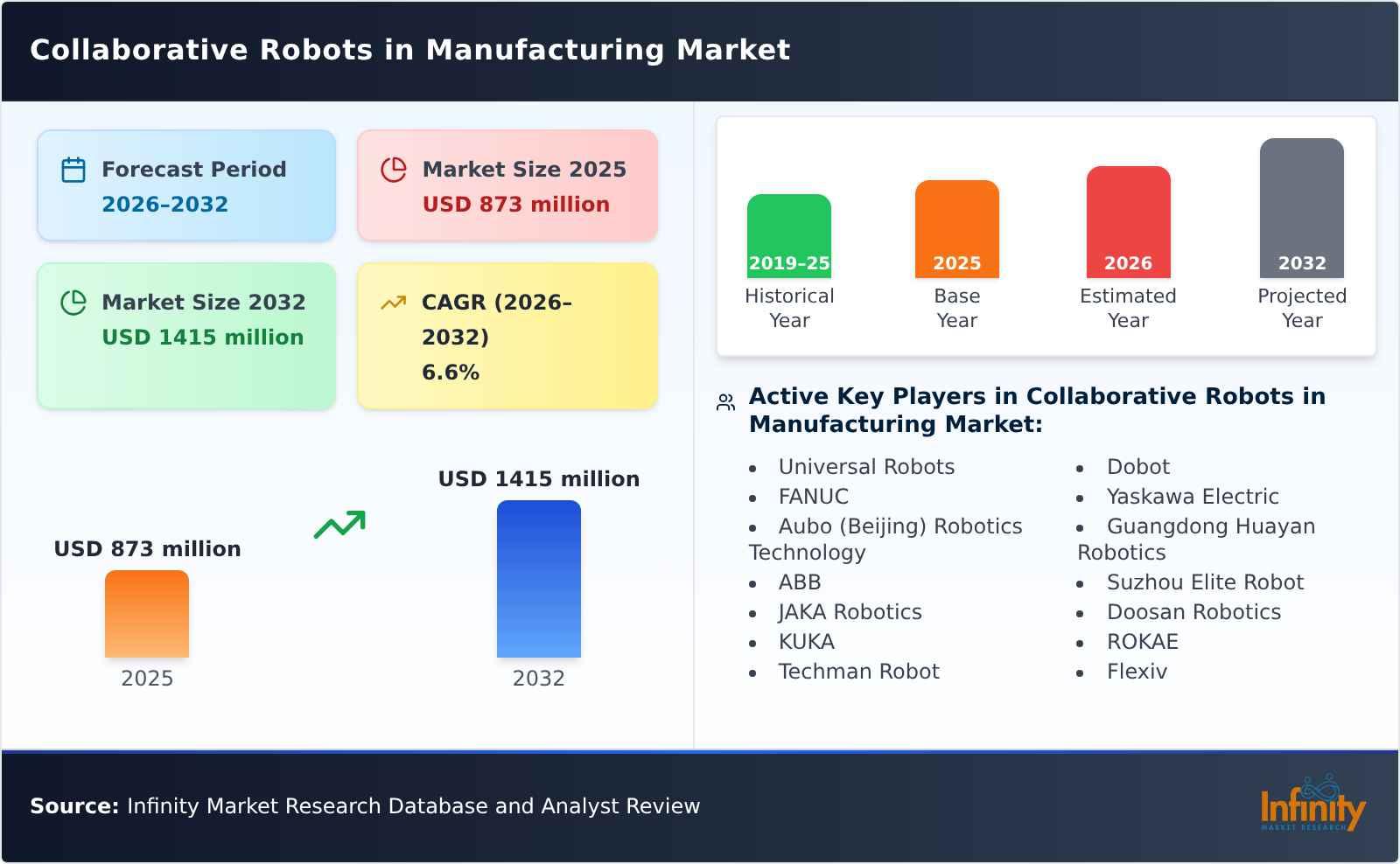
The global Collaborative Robots in Manufacturing market size is predicted to grow from US$ 873 million in 2025 to US$ 1415 million in 2032; it is expected to grow at a CAGR of 6.6% from 2026 to 2032.
Explore this report in detail? Download a free sample copy
Download Free Sample Report
Collaborative Robots in Manufacturing refers to collaborative robots (cobots) deployed in manufacturing plants to perform production and shop-floor operations in close proximity to human workers under defined safety functions. These systems typically include the robot arm, controller, safety features, and application tooling (e.g., grippers, screwdrivers, dispensing valves, vision), and are used for tasks such as machine tending/loading & unloading, assembly and screwdriving, packaging, inspection/testing, polishing/grinding, welding, and palletizing/depalletizing. Compared with general-purpose cobots, manufacturing cobots emphasize stable takt time, repeatable accuracy, integration with industrial equipment and PLC/vision systems, and fast changeovers to support high-mix, variable production. In 2025, shipments of collaborative robots in manufacturing reached 74,125 units, with an average price of US$12,042 per unit.
Collaborative Robots in Manufacturing refer to collaborative robotic systems deployed in factory and shop-floor production environments that can operate in close proximity to human workers under defined safety functions. They are typically centered on 6-axis/7-axis single-arm collaborative manipulators, and are equipped with controllers, safety functions, teach-and-program software, and application tooling such as end effectors and vision systems. These systems enable flexible automation for typical manufacturing processes including machine tending/loading & unloading, assembly, screwdriving/screw fastening, dispensing, inspection, polishing and grinding, welding, and palletizing/depalletizing. From a statistical and market-definition perspective, this segment emphasizes deployment in ?manufacturing scenarios,? with the application boundary defined around plant production and shop-floor operations, distinct from non-manufacturing scenarios such as commercial services, medical and scientific research, and warehousing/distribution logistics. In terms of industry scale and growth drivers, manufacturing cobots are primarily driven by high-mix/low-volume production, labor cost and workforce volatility, rising requirements for quality consistency and traceability, and the need for flexible production-line upgrades. On the demand side, adoption has been particularly strong in electronics and semiconductors, automotive components and 3C assembly, metalworking and machining workshops, lithium-battery and PV manufacturing, and food and daily-chemical packaging. Among these, ?material handling/machine tending, assembly/screwdriving, packaging and palletizing/depalletizing, and inspection/testing? are the most readily replicable and scalable scenarios, while processes such as polishing/grinding, welding, and dispensing rely more heavily on application packages and accumulated on-site process know-how, and therefore exhibit a stronger project-based delivery profile. From a product and application structure perspective, manufacturing cobots can be segmented by payload and reach into light-, mid-, and higher-payload tiers, and are typically delivered through a modular ecosystem of ?robot body + end-effector tooling,? such as grippers/vacuum tools, electric screwdrivers, dispensing valves, welding torches, and cameras/vision systems. For manufacturing customers, selection decisions generally prioritize takt-time stability, repeatable positioning accuracy, integration capability with machine tools/production lines/PLC and vision systems, fast changeover capability, and fault self-diagnosis and remote operation & maintenance. In terms of delivery model, standalone robot sales are more common for standardized stations and customers with stronger secondary development capability, while ?standardized workcells/industry solutions? are more conducive to scalable replication and higher certainty of project delivery. From the perspective of cost structure, single-line capacity, and profitability, the system cost of manufacturing cobots is mainly composed of core components (reducers, servos and drives, controllers, encoders/sensing and safety components), structural parts machining, assembly and testing, software and application packages, end effectors, and integration and commissioning. Among these, performance consistency and supply stability of key components directly affect overall yield and delivery lead time. On the manufacturing side, assembly and burn-in testing of collaborative arms are one of the capacity bottlenecks; under mature processes, the annual capacity of a single assembly-and-test line is typically 1,000?3,000 units, depending on model changeover frequency, test duration, and the supply cadence of key components. In terms of margins, gross margin for the robot body is commonly 20%?35%; when combined with end effectors and software application packages and delivered as workcells/solutions, overall gross margin is typically 30%?45%. As price competition intensifies, body-level margins face greater pressure, whereas companies with stronger process packages and delivery systems are better positioned to sustain profitability through system-level delivery. From the perspective of value chain structure, competitive landscape, and development trends, upstream includes core component suppliers such as reducers, servo systems, controllers, sensors, and safety components; midstream comprises collaborative robot OEMs and software platforms/ecosystem partners; downstream consists of manufacturing end users and system integrators jointly driving deployment. Competitive focus is shifting from pure parameter benchmarking toward a comprehensive capability set spanning reliability and ease of use, accumulation of process packages, channel coverage and delivery efficiency, after-sales responsiveness, and full lifecycle operation and maintenance. Looking ahead, the sector is expected to evolve toward higher payload and higher protection levels, stronger vision and AI-based perception, faster deployment and lower programming thresholds, and deeper standardization of workcells and industry solutions. As manufacturing customers move from pilots to scaled replication, engineering capability centered on availability, takt time, and yield will become a decisive factor in gaining market share.
Infinity Market Research newest research report, the ?Collaborative Robots in Manufacturing Industry Forecast? looks at past sales and reviews total world Collaborative Robots in Manufacturing sales in 2025, providing a comprehensive analysis by region and market sector of projected Collaborative Robots in Manufacturing sales for 2026 through 2032. With Collaborative Robots in Manufacturing sales broken down by region, market sector and sub-sector, this report provides a detailed analysis in US$ millions of the world Collaborative Robots in Manufacturing industry.
This Insight Report provides a comprehensive analysis of the global Collaborative Robots in Manufacturing landscape and highlights key trends related to product segmentation, company formation, revenue, and market share, latest development, and M&A activity. This report also analyzes the strategies of leading global companies with a focus on Collaborative Robots in Manufacturing portfolios and capabilities, market entry strategies, market positions, and geographic footprints, to better understand these firms? unique position in an accelerating global Collaborative Robots in Manufacturing market.
This Insight Report evaluates the key market trends, drivers, and affecting factors shaping the global outlook for Collaborative Robots in Manufacturing and breaks down the forecast by Type, by Application, geography, and market size to highlight emerging pockets of opportunity. With a transparent methodology based on hundreds of bottom-up qualitative and quantitative market inputs, this study forecast offers a highly nuanced view of the current state and future trajectory in the global Collaborative Robots in Manufacturing.
This report presents a comprehensive overview, market shares, and growth opportunities of Collaborative Robots in Manufacturing market by product type, application, key manufacturers and key regions and countries.
Segmentation by Type:
Below 5 kg
5-10 kg
More Than 10 kg
Segmentation by Number of Joint Axes:
4-axis
6-axis
7-axis
Segmentation by Application Scenarios:
Material Handling/Loading & Unloading
Assembly
Screwdriving/Screw Fastening
Polishing & Grinding
Depalletizing/Palletizing
Dispensing/Gluing
Welding
Spraying/Coating
Others
Segmentation by Application:
Electronics
Automobile
Semiconductors
Mechanical Processing
This report also splits the market by region:
Americas
United States
Canada
Mexico
Brazil
APAC
China
Japan
Korea
Southeast Asia
India
Australia
Europe
Germany
France
UK
Italy
Russia
Middle East & Africa
Egypt
South Africa
Israel
Turkey
GCC Countries
The below companies that are profiled have been selected based on inputs gathered from primary experts and analysing the companys coverage, product portfolio, its market penetration.
Universal Robots
FANUC
Aubo (Beijing) Robotics Technology
ABB
JAKA Robotics
KUKA
Techman Robot
Dobot
Yaskawa Electric
Guangdong Huayan Robotics
Suzhou Elite Robot
Doosan Robotics
ROKAE
Flexiv
Key Questions Addressed in this Report
What is the 10-year outlook for the global Collaborative Robots in Manufacturing market?
What factors are driving Collaborative Robots in Manufacturing market growth, globally and by region?
Which technologies are poised for the fastest growth by market and region?
How do Collaborative Robots in Manufacturing market opportunities vary by end market size?
How does Collaborative Robots in Manufacturing break out by Type, by Application?
Collaborative Robots in Manufacturing Market Scope
| Report Attribute | Details |
|---|---|
| Market Size (Start Year) | USD XX Million |
| Market Size (End Year) | USD XX Million |
| Compound Annual Growth Rate (CAGR) | USD XX Million |
| Forecast Period | USD XX Million |
| Base Year | USD XX Million |
| Historical Data | USD XX Million |
| Key Players | USD XX Million |
REPORT COVERAGE
Revenue forecast, Company Analysis, Industry landscape, Growth factors, and Trends
SEGMENT COVERED
By component, deployment, organization size, application, and industry.
REGIONAL SCOPE
North America, Europe, Asia Pacific, Middle East & Africa, South & Central America
COUNTRY SCOPE
Includes key countries across all major regions.
📘 Frequently Asked Questions
1. What is the market size of Global Collaborative Robots in Manufacturing Market?
Answer: The global Collaborative Robots in Manufacturing market size is predicted to grow from US$ 873 million in 2025 to US$ 1415 million in 2032; it is expected to grow at a CAGR of 6.6% from 2026 to 2032.
2. Which regions are analyzed in the Global Collaborative Robots in Manufacturing Market report?
Answer: The Global Collaborative Robots in Manufacturing Market report covers major regions such as Europe, Middle East & Africa. Each region is analyzed for trends, opportunities, and market dynamics.
3. What methodology is used for forecasting of Global Collaborative Robots in Manufacturing Market?
Answer: The Global Collaborative Robots in Manufacturing Market report uses a mix of primary research, secondary data, and expert analysis to build its forecasts. Models include both qualitative and quantitative approaches.
4. Are emerging markets analyzed separately in the Global Collaborative Robots in Manufacturing Market?
Answer: Yes, the Global Collaborative Robots in Manufacturing Market report highlights high-growth emerging regions with dedicated insights. These include untapped opportunities, risks, and potential for expansion.
5. Does the report include competitive benchmarking of Global Collaborative Robots in Manufacturing Market?
Answer: Yes, Global Collaborative Robots in Manufacturing Market report compares major players based on revenue, product portfolio, innovation, and regional presence. This helps assess competitive positioning.
6. Can I access country-level data within the Global Collaborative Robots in Manufacturing Market report?
Answer: Yes, Global Collaborative Robots in Manufacturing Market report includes detailed data by country, especially for key markets. This allows for localized insights and decision-making.
7. Can I get customized insights or data from the Global Collaborative Robots in Manufacturing Market report?
Answer: Yes, we offer customization options to align with your specific business needs. You can request tailored sections or regional breakdowns.

🔐 Secure Payment Guaranteed
Safe checkout with trusted global payment methods.
🌟 Why Choose Infinity Market Research?
At Infinity Market Research, we dont just deliver data — we deliver clarity, confidence, and competitive edge.
In a world driven by insights, we help businesses unlock the infinite potential of informed decisions.
Here why global brands, startups, and decision-makers choose us:
Industry-Centric Expertise
With deep domain knowledge across sectors — from healthcare and technology to manufacturing and consumer goods — our team delivers insights that matter.
Custom Research, Not Cookie-Cutter Reports
Every business is unique, and so are its challenges. Thats why we tailor our research to your specific goals, offering solutions that are actionable, relevant, and reliable.
Data You Can Trust
Our research methodology is rigorous, transparent, and validated at every step. We believe in delivering not just numbers, but numbers that drive real impact.
Client-Centric Approach
Your success is our priority. From first contact to final delivery, our team is responsive, collaborative, and committed to your goals — because you re more than a client; you re a partner.