


Global Peripheral Vascular Intervention Products Market Growth 2026-2032
Jan 2026
Healthcare
Pages: 126
ILR1806
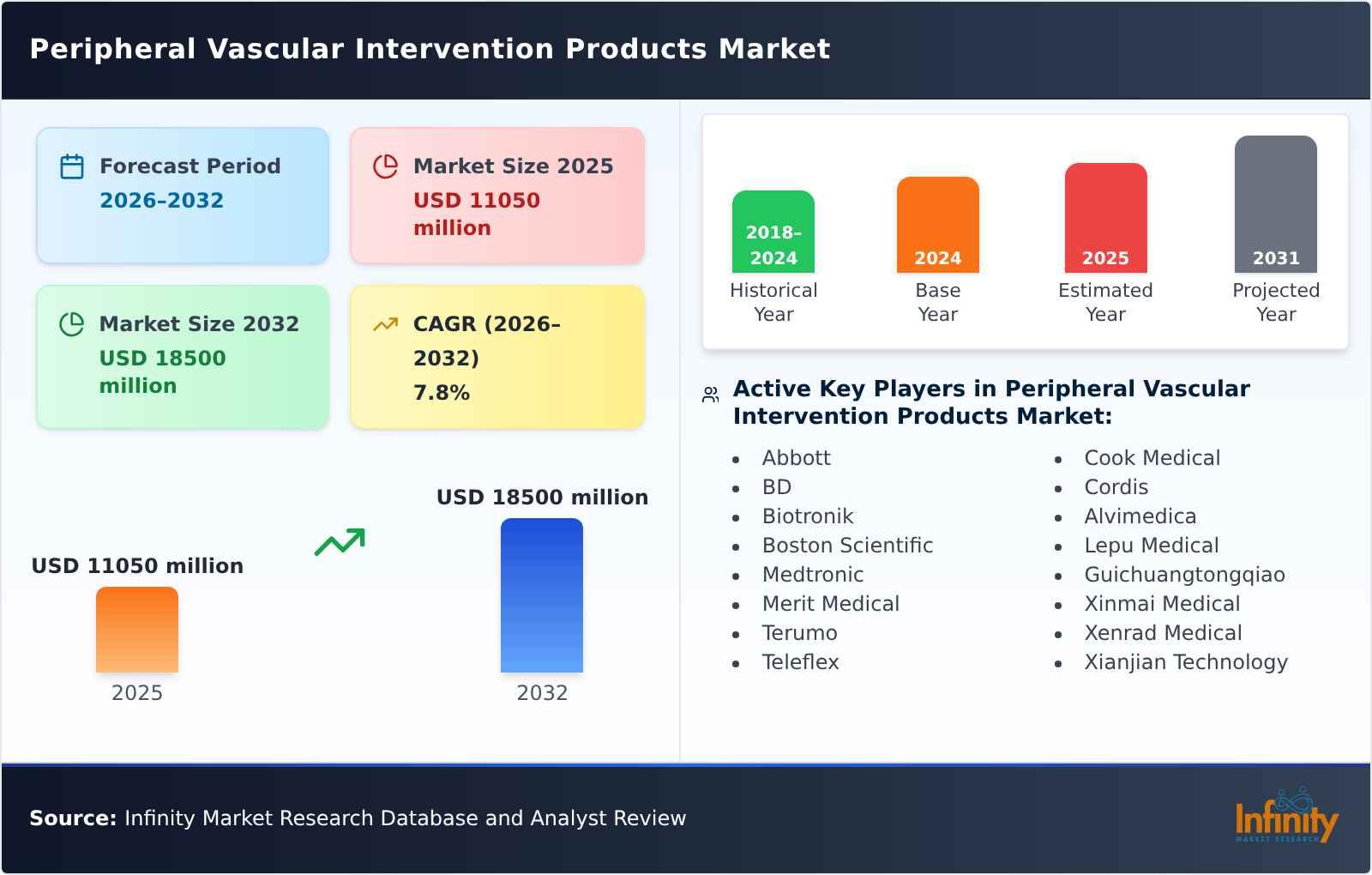
The global Peripheral Vascular Intervention Products market size is predicted to grow from US$ 11050 million in 2025 to US$ 18500 million in 2032; it is expected to grow at a CAGR of 7.8% from 2026 to 2032.
Explore this report in detail? Download a free sample copy
Download Free Sample Report
Peripheral Vascular intervention refers to medical procedures performed to diagnose and treat conditions affecting the blood vessels outside the heart and brain, primarily the arteries and veins in the arms, legs, abdomen, and pelvis. These interventions are typically minimally invasive and are aimed at restoring or improving blood flow to the affected peripheral tissues. Peripheral intervention procedures include angioplasty, stenting, atherectomy, thrombectomy, embolization, and other techniques used to address various conditions such as peripheral artery disease (PAD), deep vein thrombosis (DVT), venous insufficiency, aneurysms, and vascular malformations. These procedures are often performed by interventional radiologists, vascular surgeons, or cardiologists using catheter-based techniques guided by imaging modalities such as fluoroscopy, ultrasound, or computed tomography (CT). Peripheral intervention plays a crucial role in improving patient outcomes, relieving symptoms, preventing complications, and preserving limb function in individuals with peripheral vascular diseases.In 2025, global Peripheral Vascular Intervention Products production reached approximately 93.66 million units and price is about 120.6 USD/Unit.The average gross profit margin of this product is 73%.
Rising burdens of aging, diabetes, and atherosclerotic disease sustain long-term demand for PAD and venous thrombotic care. The clinical advantages of endovascular therapyless invasiveness, faster recovery, and repeatabilitycontinue to shift more patients from surgical to endoluminal strategies. Hospitals are also prioritizing peri-procedural efficiency and longitudinal disease management, making integrated solutions that combine devices with imaging assessment and follow-up pathways more likely to be adopted and standardized.Peripheral anatomy and lesion morphology vary widely, with a high proportion of long lesions and calcification, leading to strong outcome stratification across device strategies and persistent restenosis riskrequiring ongoing evidence building and clear indication boundaries. Complication control (perforation, dissection, distal embolization, stent fracture, etc.) raises requirements for operator expertise and device reliability. Meanwhile, cost-containment and tender dynamics intensify price pressure, forcing suppliers to prove value through real-world outcomes, comprehensive portfolios, and robust clinical educationwithout which sustainable access and brand stickiness are difficult.Downstream purchasing is shifting from single-device selection toward lesion-centered combination strategies, favoring product matrices that cover complex scenarios such as long lesions, bifurcations, calcification, and thrombosis, and that integrate well with intravascular imaging, functional assessment, and precise sizing. Drug-coated and vessel-remodeling approaches are increasingly evaluated on safety, durable patency, and reintervention management, while demand rises for simplified workflows, complication alerts, and post-procedure management tools. The growth of outpatient and day-case procedures further pushes devices toward easier use, standardization, and reproducible clinical pathways.Upstream value is anchored in high-performance metals and polymer systems. Stent frameworks commonly rely on nitinol and stainless steel; guidewires and braided structures require high-strength metallic wire. Balloons and catheters often use nylon and Pebax with braided/coil reinforcement. Hydrophilic coatings, lubricious layers, adhesives, radiopaque markers, and sterile packaging shape deliverability, visibility, and safety margins. Drug-coated devices additionally depend on consistent control of drugexcipient stability and coating uniformity. Key competitive factors include batch consistency of raw materials, precision processing and clean manufacturing, stable coating/sterilization processes, and resilient supply of critical components.
Infinity Market Research newest research report, the Peripheral Vascular Intervention Products Industry Forecast looks at past sales and reviews total world Peripheral Vascular Intervention Products sales in 2025, providing a comprehensive analysis by region and market sector of projected Peripheral Vascular Intervention Products sales for 2026 through 2032. With Peripheral Vascular Intervention Products sales broken down by region, market sector and sub-sector, this report provides a detailed analysis in US$ millions of the world Peripheral Vascular Intervention Products industry.
This Insight Report provides a comprehensive analysis of the global Peripheral Vascular Intervention Products landscape and highlights key trends related to product segmentation, company formation, revenue, and market share, latest development, and M&A activity. This report also analyzes the strategies of leading global companies with a focus on Peripheral Vascular Intervention Products portfolios and capabilities, market entry strategies, market positions, and geographic footprints, to better understand these firms unique position in an accelerating global Peripheral Vascular Intervention Products market.
This Insight Report evaluates the key market trends, drivers, and affecting factors shaping the global outlook for Peripheral Vascular Intervention Products and breaks down the forecast by Type, by Application, geography, and market size to highlight emerging pockets of opportunity. With a transparent methodology based on hundreds of bottom-up qualitative and quantitative market inputs, this study forecast offers a highly nuanced view of the current state and future trajectory in the global Peripheral Vascular Intervention Products.
This report presents a comprehensive overview, market shares, and growth opportunities of Peripheral Vascular Intervention Products market by product type, application, key manufacturers and key regions and countries.
Segmentation by Type:
Stent
Catheter
Guidewire
Sheath
Vena Cava Filter
Other
Segmentation by Vascular Bed:
Lower Limb Artery
Carotid/Neck
Vein
Renal/Visceral Artery
Other
Segmentation by Drug Strategy:
Non-drug
Drug-coated
Drug-eluting
Other
Segmentation by Application:
Arterial Diseases
Venous Diseases
This report also splits the market by region:
Americas
United States
Canada
Mexico
Brazil
APAC
China
Japan
Korea
Southeast Asia
India
Australia
Europe
Germany
France
UK
Italy
Russia
Middle East & Africa
Egypt
South Africa
Israel
Turkey
GCC Countries
The below companies that are profiled have been selected based on inputs gathered from primary experts and analysing the companys coverage, product portfolio, its market penetration.
Abbott
BD
Biotronik
Boston Scientific
Medtronic
Merit Medical
Terumo
Teleflex
Cook Medical
Cordis
Alvimedica
Lepu Medical
Guichuangtongqiao
Xinmai Medical
Xenrad Medical
Xianjian Technology
Weigao Shares
Bomei Medical
Dingke Medical
Zhejiang Batai Medical
Key Questions Addressed in this Report
What is the 10-year outlook for the global Peripheral Vascular Intervention Products market?
What factors are driving Peripheral Vascular Intervention Products market growth, globally and by region?
Which technologies are poised for the fastest growth by market and region?
How do Peripheral Vascular Intervention Products market opportunities vary by end market size?
How does Peripheral Vascular Intervention Products break out by Type, by Application?
Peripheral Vascular Intervention Products Market Scope
| Report Attribute | Details |
|---|---|
| Market Size (Start Year) | USD XX Million |
| Market Size (End Year) | USD XX Million |
| Compound Annual Growth Rate (CAGR) | USD XX Million |
| Forecast Period | USD XX Million |
| Base Year | USD XX Million |
| Historical Data | USD XX Million |
| Key Players | USD XX Million |
REPORT COVERAGE
Revenue forecast, Company Analysis, Industry landscape, Growth factors, and Trends
SEGMENT COVERED
By component, deployment, organization size, application, and industry.
REGIONAL SCOPE
North America, Europe, Asia Pacific, Middle East & Africa, South & Central America
COUNTRY SCOPE
Includes key countries across all major regions.
Frequently Asked Questions
1. What is the market size of Global Peripheral Vascular Intervention Products Market?
Answer: The global Peripheral Vascular Intervention Products market size is predicted to grow from US$ 11050 million in 2025 to US$ 18500 million in 2032; it is expected to grow at a CAGR of 7.8% from 2026 to 2032.
2. Which regions are analyzed in the Global Peripheral Vascular Intervention Products Market report?
Answer: The Global Peripheral Vascular Intervention Products Market report covers major regions such as Europe, Middle East & Africa. Each region is analyzed for trends, opportunities, and market dynamics.
3. What methodology is used for forecasting of Global Peripheral Vascular Intervention Products Market?
Answer: The Global Peripheral Vascular Intervention Products Market report uses a mix of primary research, secondary data, and expert analysis.
4. Are emerging markets analyzed separately in the Global Peripheral Vascular Intervention Products Market?
Answer: Yes, the Global Peripheral Vascular Intervention Products Market report highlights high-growth emerging regions with dedicated insights.
5. Does the report include competitive benchmarking of Global Peripheral Vascular Intervention Products Market?
Answer: Yes, Global Peripheral Vascular Intervention Products Market report compares major players based on revenue, product portfolio, and innovation.
6. Can I access country-level data within the Global Peripheral Vascular Intervention Products Market report?
Answer: Yes, Global Peripheral Vascular Intervention Products Market report includes detailed data by country for major regions.
7. Can I get customized insights or data from the Global Peripheral Vascular Intervention Products Market report?
Answer: Yes, we offer customization options to align with your specific business needs. You can request tailored sections or regional breakdowns.